 Real photograph
 Great scallop
Pecten maximus
say it GRAYT SKOL-uhp
Why we love them
The great scallop is a shellfish with a beautiful fan-shaped shell, the kind you might spot on a beach or on old paintings and postcards. It lives on sandy and gravelly seabeds in the cool waters around Europe. Its two curved shells, called valves, fit together like a case, keeping the soft animal safely tucked inside.
Here is a wonderful surprise: a scallop can swim! Most of the time it lies quietly in a little hollow in the sand, but if it needs to move, it claps its two shells together again and again. Each clap squirts out jets of water, and the scallop goes zipping along through the sea with the curved edge of its shell leading the way. It looks a bit like a chattering pair of castanets bouncing off across the seabed.
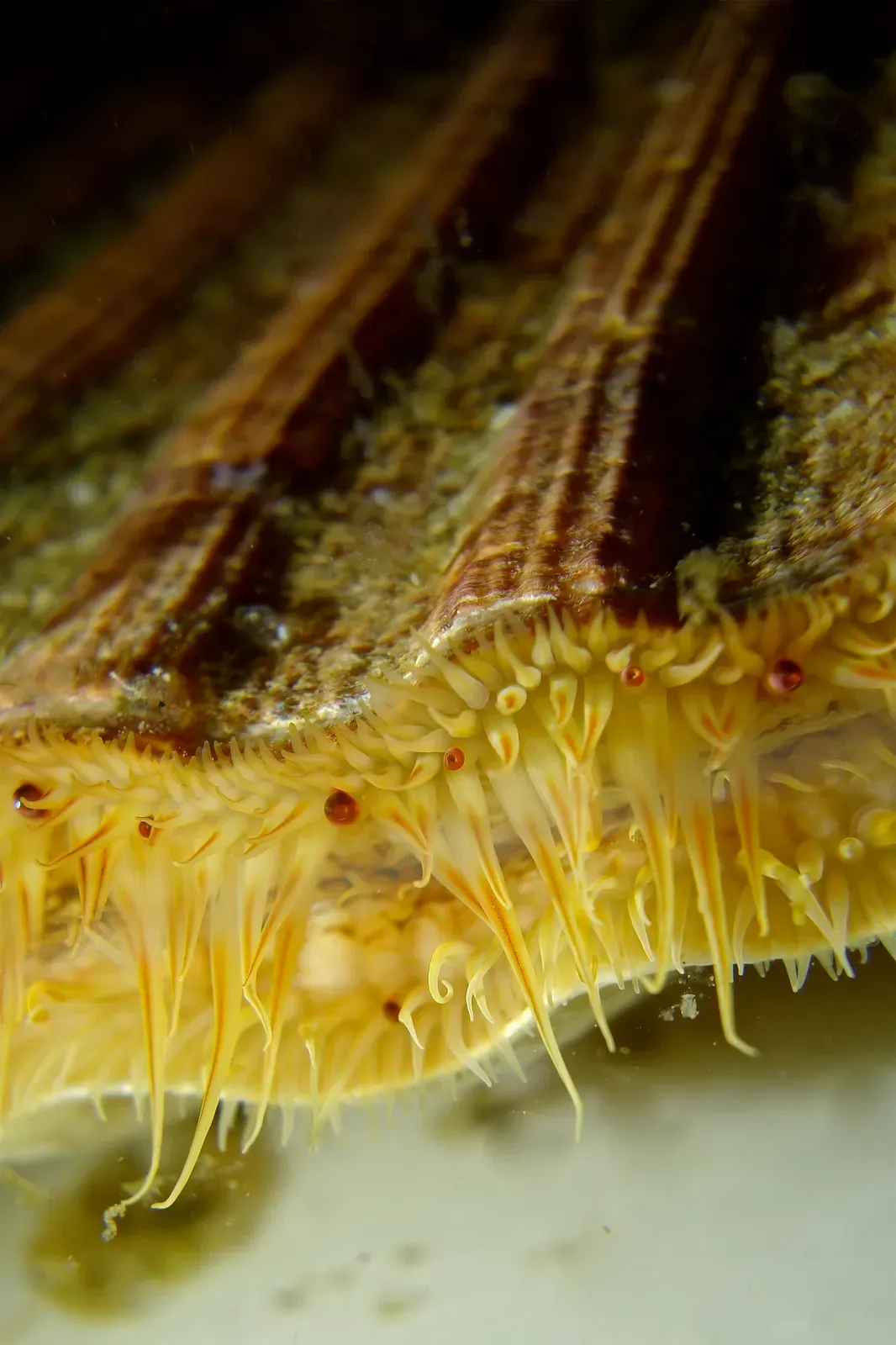
Even more amazing, the great scallop has eyes — lots of them! Along the edge of its shell sit rows of tiny eyes, around 30 to 36 of them, glinting blue or green like little jewels. These eyes cannot see clear pictures, but they can spot shadows and movement. If something creeps too close, the scallop senses it and claps away to safety.
The great scallop is a filter feeder. It gently draws seawater in over its gills and sieves out tiny drifting specks of food, such as plankton, that are far too small for us to see. By quietly filtering the water all day, it feeds itself without ever needing to chase or hunt a single thing.
Great scallops live across the north-eastern Atlantic, from Norway down past the British Isles to Spain and beyond. Where they are left undisturbed, they can live for more than 20 years and grow shells about 15 centimetres across. They have not been given an official rating on the IUCN Red List, but these clever, swimming shellfish remain a familiar sight on the seabed.
My home
Seafloor, sandy seabed, coastal waters
Where I live
Europe, Atlantic Ocean
What I eat
Plankton, tiny sea particles
How long I am
0.21 m
How long I live
20 years
A great scallop can actually swim! It claps its two shells together, squirting out jets of water so it zips along with the curved edge of its shell in front.
It has rows of tiny eyes — around 30 to 36 of them, coloured blue or green — lining the edge of its shell to watch for movement.
Where it is left undisturbed, a great scallop can live for more than 20 years and grow a shell about 15 centimetres or more across.
Every great scallop can feel happy, scared and loved — just like you.
Looking after my friends
Not checked yetNo one has counted them carefully yet.
You can help by learning their names, keeping wild places clean, and telling someone why this animal matters.
Where this came from
- Pecten maximus — IUCN Red List (no assessment found) — IUCN Red List of Threatened Species
- Great scallop (Pecten maximus) — Biology and Sensitivity Review — MarLIN — The Marine Life Information Network (Marine Biological Association)
- Pecten maximus — Wikipedia