 Real photograph
 Blue mussel
Mytilus edulis
say it BLOO MUH-suhl
Why we love them
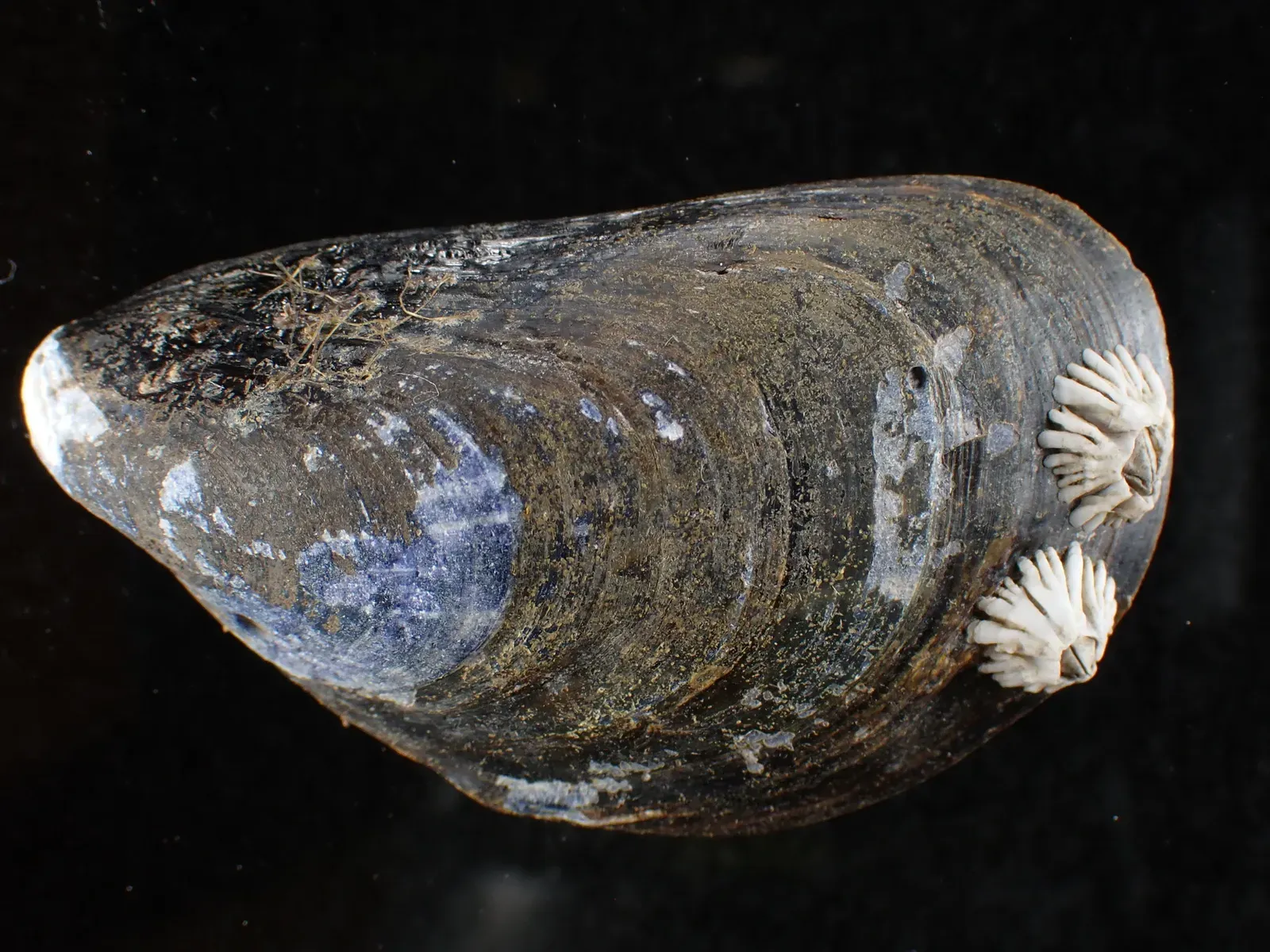
The blue mussel is a small shellfish with a smooth, blue-black shell shaped a little like a teardrop. It lives along busy, splashy seashores, clinging to rocks, piers, and ropes where the waves roll in and out. Inside its two shells, the soft animal stays safe and cosy, opening up just a little when it is time to eat.
Blue mussels have a clever trick for holding on. Using a small, stretchy body part called a foot, a mussel spins strong threads called byssus, which set as hard as tough little ropes. These silk-like threads glue the mussel firmly to the rocks, so even when powerful waves crash over it again and again, the mussel stays right where it wants to be.
A blue mussel eats by filtering the water. It draws seawater in through its shell, then combs out tiny drifting specks of food, such as plankton, and swallows them up. As it feeds, it also traps bits of dirt and cloudy stuff floating in the sea. In this way, a bed of mussels quietly helps keep the water around them clearer and cleaner.
Mussels love company. They live packed close together in huge groups called mussel beds, all anchored side by side by their byssus threads. These crowded beds become little seaside towns, giving shelter and safety to crabs, small fish, and other tiny creatures that hide among the shells. A mussel is never lonely on a busy shore.
Blue mussels are found on cool, rocky coasts on both sides of the North Atlantic, around Europe and North America. They have not been given an official rating on the IUCN Red List, but they are common and important animals of the seashore, filtering the water and building homes for their neighbours, day after day.
My home
Rocky shore, intertidal zone, coastal waters
Where I live
Europe, North America, Atlantic Ocean
What I eat
Plankton, tiny sea particles
How long I am
0.1 m
A blue mussel holds on tight with strong, silk-like threads called byssus, which it makes with its foot to anchor itself to rocks and to other mussels.
It is a filter feeder that cleans the sea as it eats, sieving tiny specks of food and even bits of dirt out of the water.
Blue mussels live crowded close together in big groups called mussel beds, where they help shelter other little sea creatures.
Every blue mussel can feel happy, scared and loved — just like you.
Looking after my friends
Not checked yetNo one has counted them carefully yet.
You can help by learning their names, keeping wild places clean, and telling someone why this animal matters.
Where this came from
- Mytilus edulis — IUCN Red List (no assessment found) — IUCN Red List of Threatened Species
- Common mussel (Mytilus edulis) — Biology and Sensitivity Review — MarLIN — The Marine Life Information Network (Marine Biological Association)
- Blue mussel — Wikipedia