 Real photograph
 Chambered nautilus
Nautilus pompilius
say it NAW-tuh-luss
Why we love them
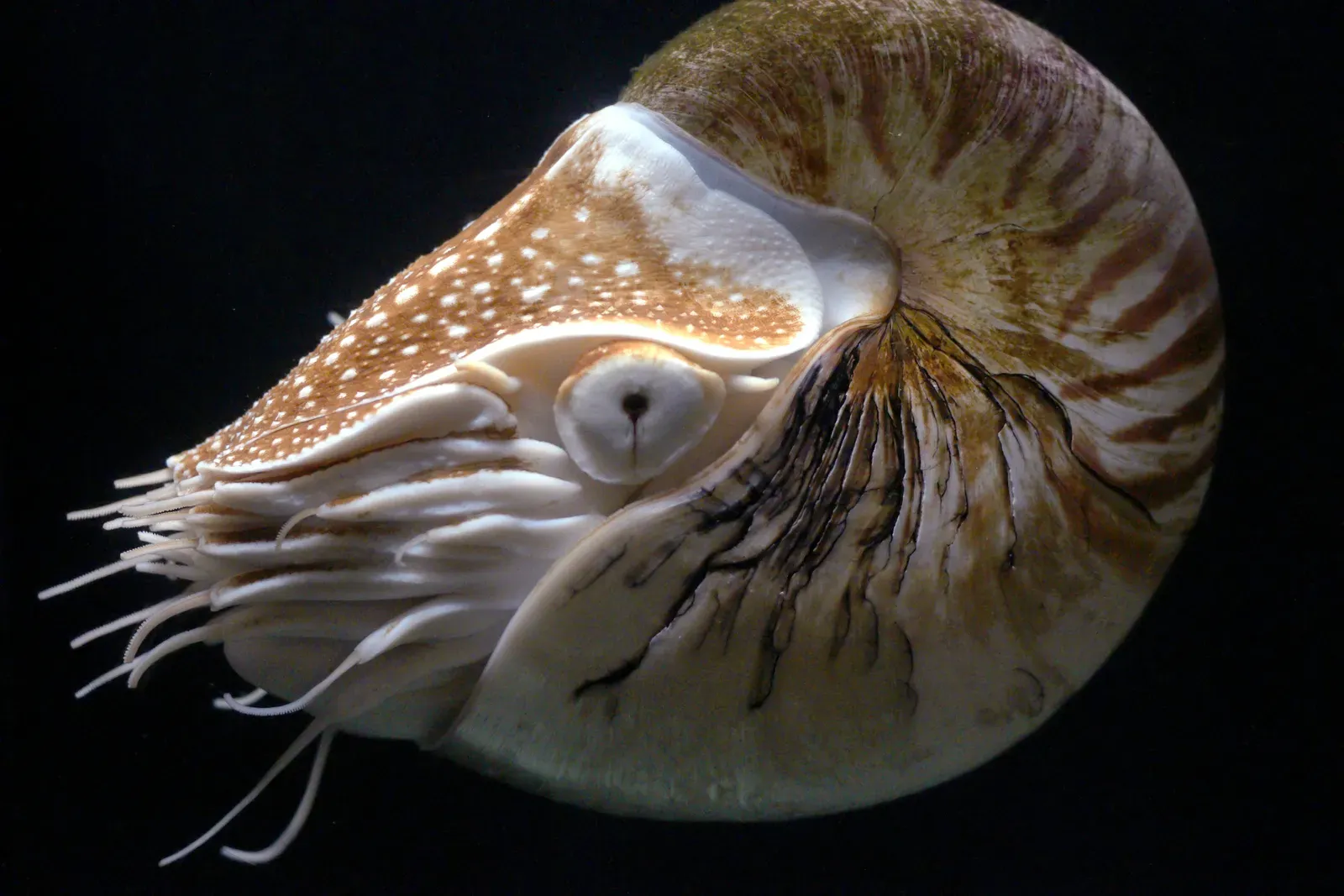
The chambered nautilus is a sea animal that carries a beautiful spiral shell wherever it goes. It is a cousin of the octopus and the squid, but it is the only one of that family that wears a hard shell on the outside.
The shell is not just one space inside. It is split into more than thirty little rooms, all joined by a thin tube. The nautilus lives only in the biggest, newest room at the front, and it can pull a soft, leathery hood over the opening like a little door to stay safe.
The old, empty rooms are very useful. By moving water and gas in and out of them, the nautilus can make itself float higher or sink lower in the sea, a bit like a tiny submarine. To move along, it squirts a jet of water and glides gently backwards.
Instead of the eight arms of an octopus, a nautilus has dozens of thin, soft feelers around its mouth, but they have no suckers. Its eyes are very simple, with no lens inside, so it mostly finds its meals of crab, shellfish, and leftover scraps by smell in the deep, dark water.
Nautiluses live slowly and take years to grow up before they are ready to have young. Sadly, many are caught for their pretty shells, so their numbers are falling and they are now listed as Vulnerable. Looking after the reefs and leaving their shells in the sea helps these gentle old sailors keep drifting through the ocean.
My home
Ocean, coral reef, deep sea slope
Where I live
Pacific Ocean, Indian Ocean
What I eat
Carrion, crabs, shellfish, detritus
A nautilus builds its shell in a spiral of many little rooms, and it only lives in the newest, biggest one.
It floats up and down by changing the water and gas inside its old rooms, a bit like a tiny submarine.
Its eyes have no lens, so it mostly finds its food by smell.
Every chambered nautilus can feel happy, scared and loved — just like you.
Looking after my friends
Needs our helpTheir numbers are getting smaller, so people are working to protect their homes.
You can help by learning their names, keeping wild places clean, and telling someone why this animal matters.
Where this came from
- Nautilus pompilius (Chambered Nautilus) — Red List Assessment — IUCN Red List of Threatened Species
- Chambered Nautilus — The Australian Museum — Australian Museum
- Chambered nautilus — Wikipedia — Wikipedia