 Real photograph
 Giant Pacific octopus
Enteroctopus dofleini
say it JY-unt puh-SIF-ik OK-tuh-puss
Why we love them
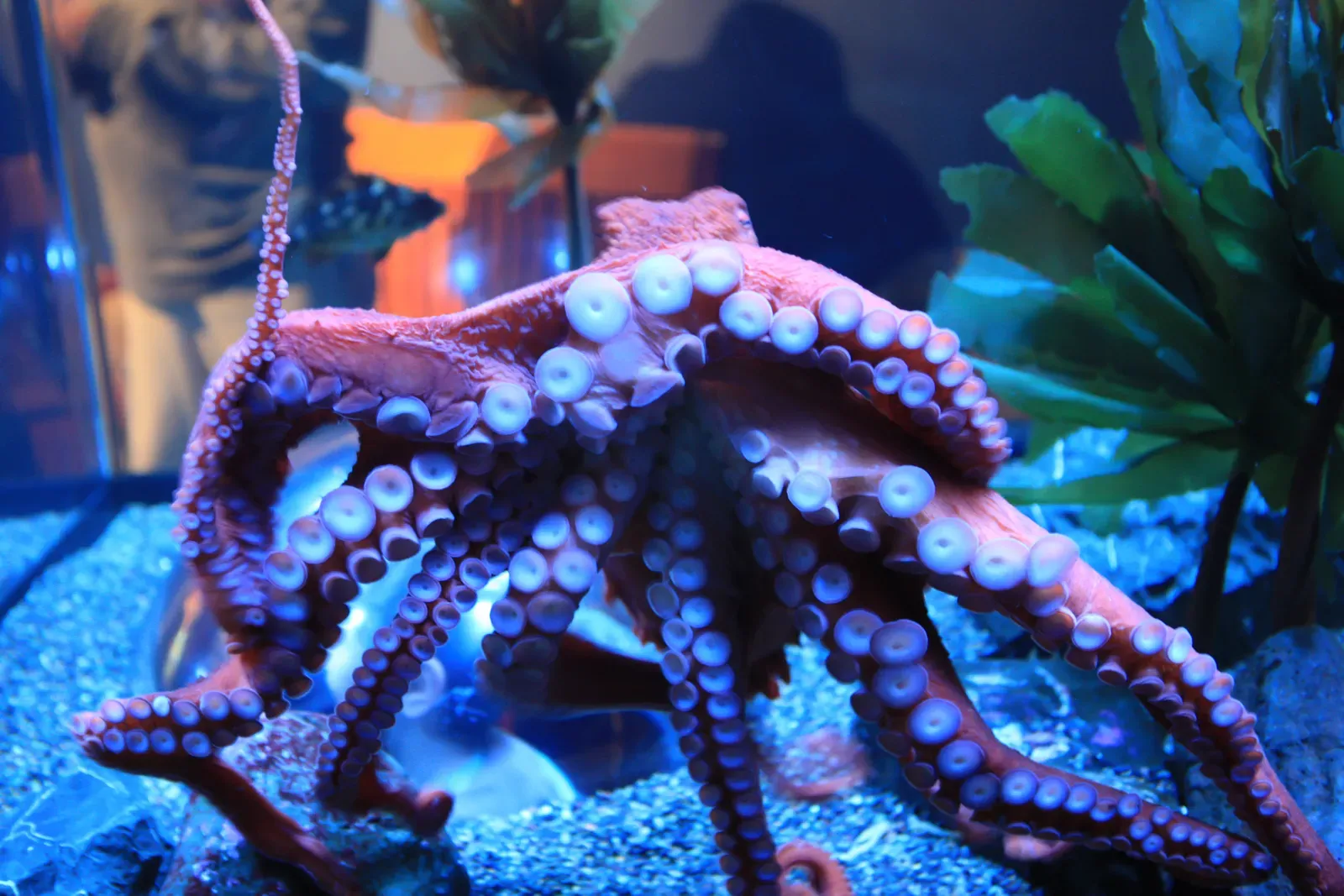
The giant Pacific octopus is one of the largest octopuses. It lives in the cool waters of the North Pacific Ocean, from California all the way to Japan. Its head is round and soft, and eight long arms trail out behind it. Those arms can spread wider than a car is long.
Each arm is lined with rows of round suckers. The octopus has thousands of them, and it uses them to feel, to taste, and to hold on tight. With its suckers it catches crabs, clams, shrimp and snails, then cracks them open with a hard beak hidden under its arms.
Like other octopuses, this one is a master of hiding. Tiny colour spots in its skin let it turn from red to grey in a moment, and it can even make its skin smooth or bumpy to match a rock. If it wants to slip away, it can squeeze its whole soft body through a surprisingly small gap.
A giant Pacific octopus lives only about three to five years, which is longer than most octopuses. Near the end of her life, a mother finds a safe den and lays tens of thousands of little eggs. She stays and guards them for months, gently fanning fresh water over them and never leaving to eat.
When the eggs finally hatch, clouds of tiny octopuses drift away into the sea. Scientists say there are still plenty of these gentle giants in the ocean, though people do need to look after their cold, rocky home.
My home
Ocean, rocky seabed, coastal waters, tidepools
Where I live
Pacific Ocean
What I eat
Crabs, clams, shrimp, scallops, snails, fish
How long I am
3–5 m
How heavy I am
10–50 kg
How long I live
3–5 years
It is among the largest octopuses, with arms that can stretch wider than a car.
It can change the colour and even the bumpiness of its skin to blend in with rocks and sand.
A mother lays tens of thousands of tiny eggs and guards them for months without eating.
Every giant pacific octopus can feel happy, scared and loved — just like you.
Looking after my friends
Doing wellThere are lots of these animals in the wild right now. That is good news!
You can help by learning their names, keeping wild places clean, and telling someone why this animal matters.
Where this came from
- Enteroctopus dofleini (Giant Pacific Octopus) — Red List Assessment — IUCN Red List of Threatened Species
- Giant Pacific Octopus — Online Learning Center — Aquarium of the Pacific
- Giant Pacific octopus — Wikipedia