 Real photograph
 Tardigrade
Tardigrada
say it TAR-dih-grayd
Why we love them
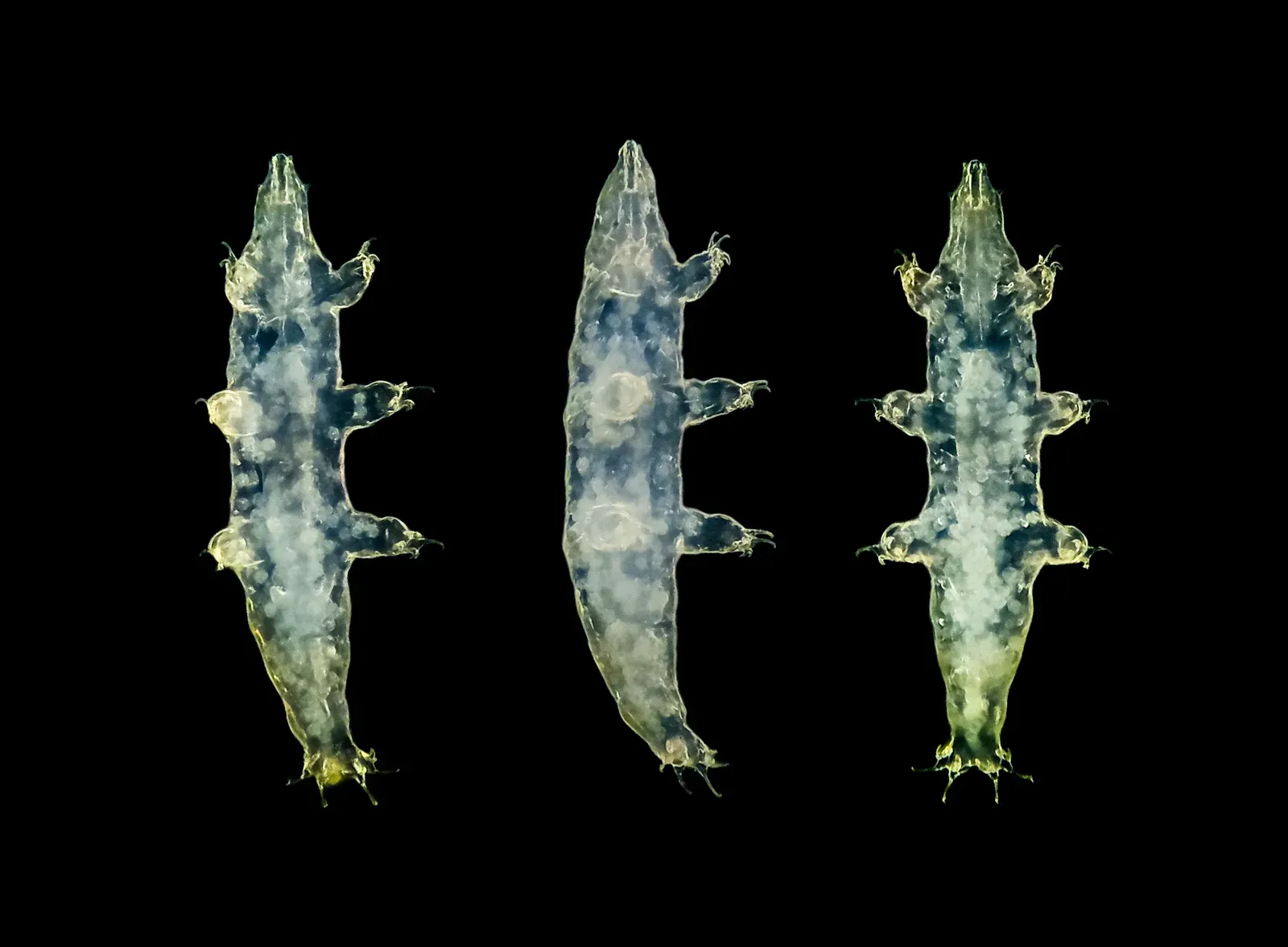
The tardigrade is one of the smallest and most amazing animals on Earth. It is so tiny — usually smaller than a grain of salt — that you need a microscope to spot one. Under the lens you can see a chubby little body with eight stubby legs, each tipped with tiny claws. People gave it two perfect nicknames: the “water bear,” because it plods along like a slow, round bear, and the “moss piglet,” because it loves to live in soft green moss.
There is not just one kind of tardigrade — there are more than a thousand different species, and scientists sort them into one big animal group called Tardigrada. Some, like the little water bears named Milnesium and Hypsibius, are favourites for looking at under a microscope. Because this page is about the whole family of water bears, it tells the story of the group rather than just one kind.
Water bears have an incredible superpower: they can survive almost anything. When their watery home dries up, a tardigrade pulls in its legs and curls into a tiny ball called a “tun.” In this sleepy state it can go without food or water for years. It can be deep-frozen to far colder than the coldest winter, heated up, squeezed by enormous pressure, and it still wakes up again once it gets a drink of water.
Scientists have even sent tardigrades into space to see what would happen. Out there they faced the freezing, airless emptiness beyond our sky — and many of the little water bears came back and carried on as if nothing had happened. Very few animals in the whole world can do that.
Because they are so tough, tardigrades live nearly everywhere on Earth. They turn up on the tops of tall mountains, deep down on the ocean floor, in warm rainforests, on frozen Antarctica, and in the mossy, damp corners of ordinary gardens. There may be water bears living just outside your door right now, napping in a cushion of moss and waiting for the next drop of rain.
My home
Moss, lichen, leaf litter, freshwater, ocean floor, soil
Where I live
Africa, Asia, Europe, North America, South America, Oceania, Antarctica
What I eat
Plant cell fluids, algae, bacteria, tiny animals, detritus
How long I am
0.00005–0.0013 m
Tardigrades are so tiny — usually smaller than a grain of salt — that you need a microscope to see one, yet they have a plump body and eight little legs like a chubby bear.
A tardigrade can survive being dried out, deep-frozen, boiled, squished by huge pressure, and even blasted with the cold vacuum of outer space, then wake up again when it finds water.
Water bears live almost everywhere on Earth — from the tops of tall mountains to the deep sea, from steamy rainforests to icy Antarctica, and even in the mossy patches in your garden.
Every tardigrade can feel happy, scared and loved — just like you.
Looking after my friends
Not checked yetNo one has counted them carefully yet.
You can help by learning their names, keeping wild places clean, and telling someone why this animal matters.
Where this came from
- Tardigrada (water bears) — IUCN Red List status (Not Evaluated) — IUCN Red List of Threatened Species
- Tardigrada (water bears) — Animal Diversity Web, University of Michigan Museum of Zoology
- Tardigrade — Wikipedia