 Real photograph
 Smooth Newt
Lissotriton vulgaris
say it SMOOTH NYOOT
Why we love them
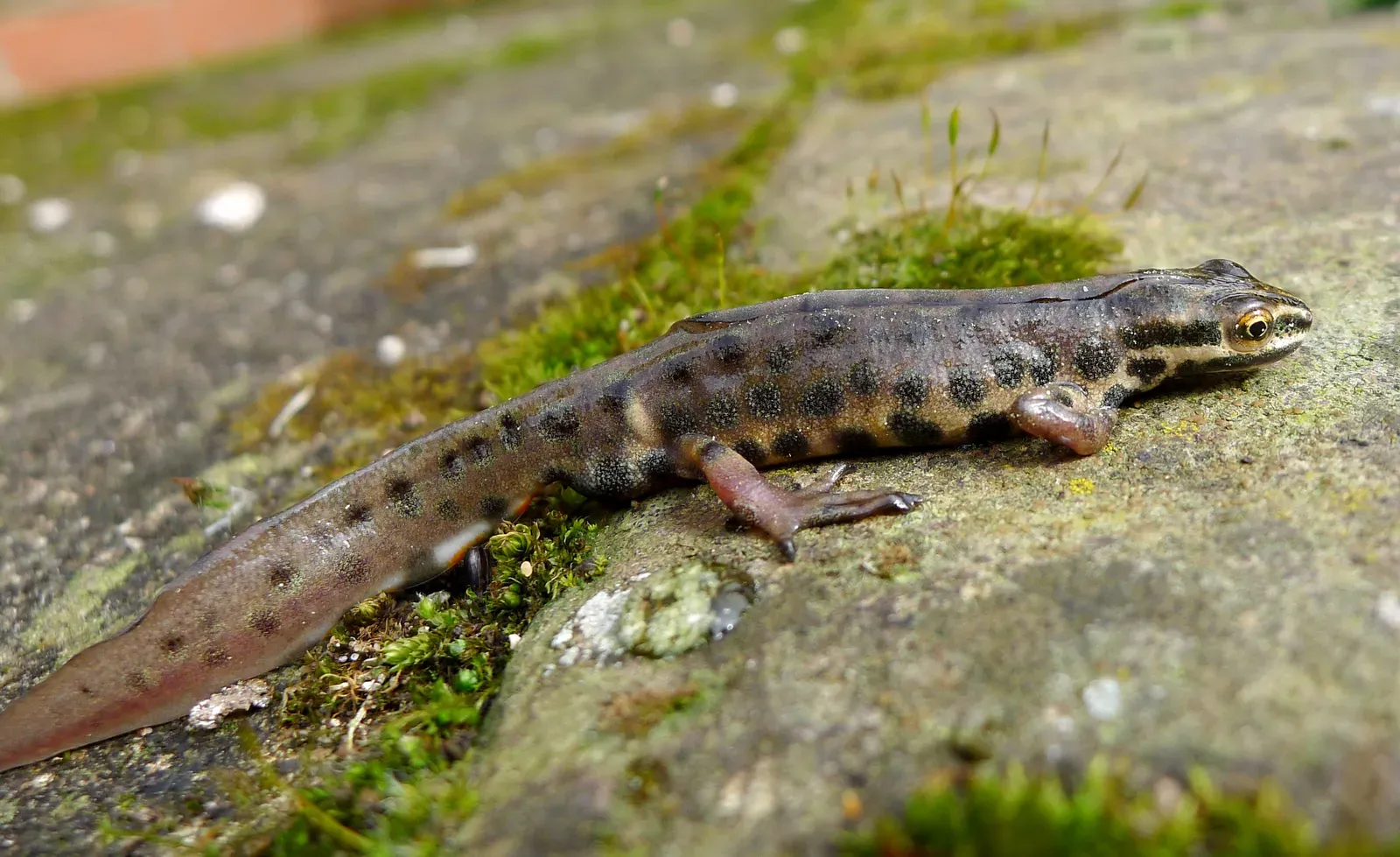
The smooth newt is a small, friendly amphibian that looks a bit like a tiny dragon. It is brown on top with a spotted orange-and-white tummy, and it grows to only about eight to eleven centimetres long. Smooth newts are found across Europe and into parts of Asia, living in ponds, ditches, damp meadows, woods, and even garden ponds. On land their skin looks dry and velvety, but in the water it becomes lovely and smooth.
Smooth newts live a kind of double life. For part of the year they wander about on land, hiding under logs and stones and hunting in the damp. Then, when spring comes, they travel back to ponds and ditches to breed in the water. Being at home both on land and in water is one of the special things that makes an amphibian an amphibian.
Springtime brings a wonderful change to the males. The male smooth newt grows a wavy crest that runs all along his back and tail, and his colours turn brighter. Wearing his fancy crest, he swims and wiggles in front of the females to show off. It is a bit like putting on a special costume just for the breeding season.
After the eggs are laid, tiny babies called larvae hatch out in the water. They have feathery gills for breathing underwater, a little like tadpoles, so they can stay safe in the pond while they grow. Over the summer they slowly change, growing legs and losing their gills, until at last they are ready to climb out and explore the land.
Smooth newts are unfussy carnivores. They eat earthworms, snails, slugs, insects and their larvae, spiders, and even tiny floating creatures called plankton. They hunt slowly and patiently, snapping up whatever small creatures come near.
The smooth newt is common across much of its range, so it is listed as least concern, which means it is not in danger overall. Even so, it can struggle when ponds are filled in or when fish are added to its breeding water. People help smooth newts by looking after ponds and digging new ones, giving these gentle little newts plenty of safe places to live and raise their young.
My home
Pond, ditch, woodland, meadow, garden, marsh
Where I live
Asia, Europe
What I eat
Earthworms, snails, slugs, insects, insect larvae, spiders, plankton
How long I am
0.08–0.11 m
How long I live
4–20 years
In spring, the male smooth newt grows a wavy crest along his back and tail and turns brighter in colour to show off in the water.
Smooth newts live a kind of double life, spending part of the year on land and then returning to ponds and ditches to breed in the water.
Baby newts, called larvae, hatch in the water with feathery gills, a little like tadpoles, before growing legs and coming out onto land.
Every smooth newt can feel happy, scared and loved — just like you.
Looking after my friends
Doing wellThere are lots of these animals in the wild right now. That is good news!
You can help by learning their names, keeping wild places clean, and telling someone why this animal matters.
Where this came from
- Lissotriton vulgaris (Smooth Newt) — Red List Assessment — IUCN Red List of Threatened Species
- Lissotriton vulgaris — Classification — Animal Diversity Web, University of Michigan Museum of Zoology
- Smooth newt — Wikipedia