 Real photograph
 Leatherback sea turtle
Dermochelys coriacea
say it LETH-ur-bak
Why we love them
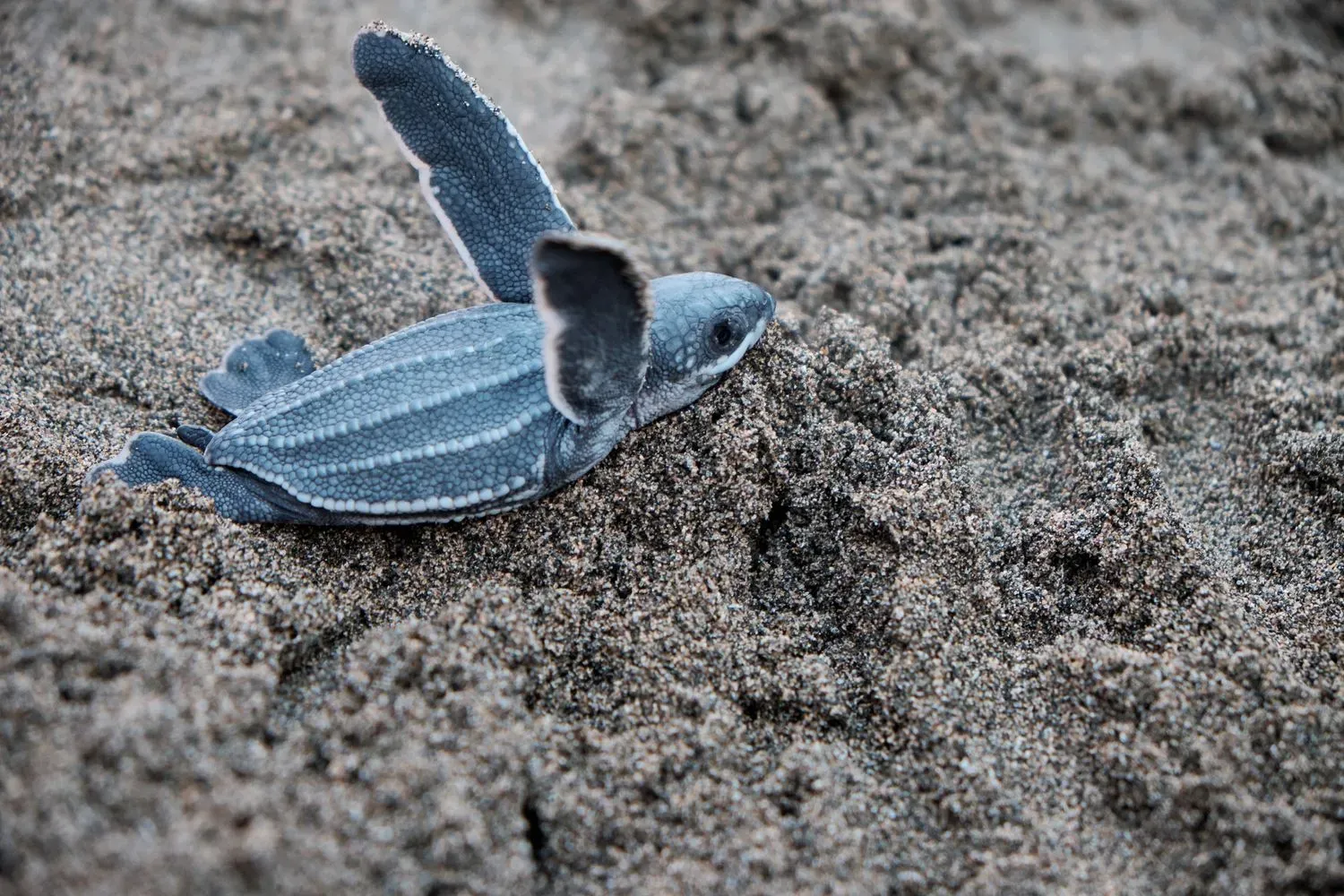
The leatherback is the largest turtle in the whole world. It is different from other sea turtles because it does not have a hard shell. Instead, its back is covered in tough, rubbery skin with seven long ridges running from front to back. Its two front flippers are very long and help it swim great distances.
Leatherbacks love to eat jellyfish and other soft, jelly-like sea creatures. Their mouth and throat have pointy, backward-facing spines inside, which help them hold onto their slippery, wobbly food so it does not slide away.
This turtle is a wonderful diver and swimmer. It can dive down deeper than any other turtle, far into the dark water, and hold its breath for a long time. It also travels enormous distances, swimming across whole oceans between the places where it eats and the beaches where it nests.
Leatherbacks live in oceans all around the world, from warm seas to cooler ones. Mother turtles come ashore on sandy tropical beaches at night to lay their eggs in the warm sand. After a while, tiny hatchlings dig their way out and hurry down to the sea.
There are fewer leatherbacks than there used to be, so people work hard to help them. Kind rules protect their nesting beaches, keep their eggs safe, and help turtles avoid getting tangled in fishing nets, so these gentle giants have a better chance to grow up and swim free.
My home
Open ocean, coastal waters, tropical beaches
Where I live
Pacific Ocean, Atlantic Ocean, Indian Ocean
What I eat
Jellyfish, salps
How long I am
1.5–1.8 m
How heavy I am
340–454 kg
How long I live
50 years
The leatherback is the biggest turtle in the whole world.
Instead of a hard shell, it has tough, rubbery skin with long ridges down its back.
It loves to eat jellyfish and can dive deeper than any other turtle.
Every leatherback sea turtle can feel happy, scared and loved — just like you.
Looking after my friends
Needs our helpTheir numbers are getting smaller, so people are working to protect their homes.
You can help by learning their names, keeping wild places clean, and telling someone why this animal matters.
Where this came from
- Dermochelys coriacea (Leatherback) — IUCN Red List conservation status — IUCN Red List of Threatened Species
- Leatherback Turtle — NOAA Fisheries (National Oceanic and Atmospheric Administration)
- Leatherback sea turtle — Wikipedia