 Real photograph
 Blue-tongued Skink
Tiliqua scincoides
say it BLOO-tungd SKINK
Why we love them
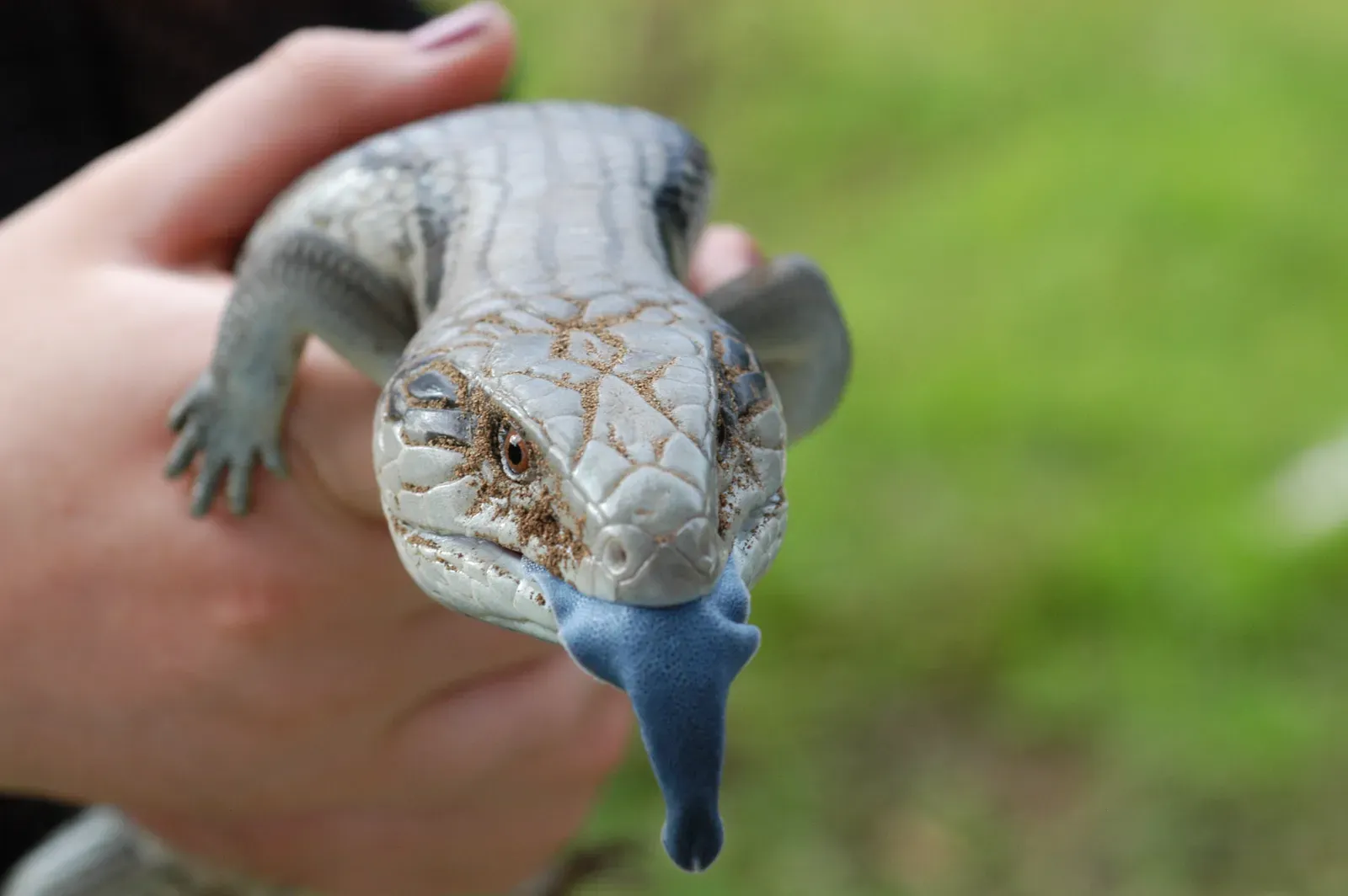
The blue-tongued skink is a chunky, friendly-looking lizard with smooth, shiny scales and short little legs. It lives across much of Australia, as well as on the Tanimbar Islands of Indonesia, and you can spot it in woodlands, grasslands, and even quiet suburban gardens. Because its legs are so short, it moves with a slow, gentle waddle.
The most special thing about this skink is hiding right inside its mouth — a bright blue tongue! Blue-tongued skinks are shy and calm animals, but if something gives them a fright, they open wide, stick out that blue tongue, puff up their body, and give a loud hiss. This makes them look bigger and more surprising, which helps a predator decide to leave them alone.
Blue-tongued skinks are omnivores, so they enjoy lots of different foods. They munch on insects and snails, and they also like flowers, fruits, and berries. As they waddle slowly across the ground, they use their nose and tongue to sniff out whatever tasty snack they can find.
Here is another surprise: instead of laying eggs like many reptiles, eastern and northern blue-tongued skinks give birth to live baby lizards. A mother can have quite a large family at once, sometimes as many as 5 to 24 little skinks. The babies are ready to look after themselves soon after they are born.
Happily, blue-tongued skinks are listed as Least Concern, which means they are still common across their range. They are a welcome sight in many Australian backyards, where they help gardeners by eating snails and slugs. Leaving out logs, leaves, and safe hiding spots gives these gentle lizards a cosy place to call home.
My home
Woodland, grassland, scrubland, suburban gardens
Where I live
Asia, Oceania
What I eat
Insects, snails, flowers, fruits, berries
How long I am
0.33 m
How heavy I am
0.49 kg
This gentle lizard has a bright blue tongue, and when something startles it, it opens its mouth, sticks out the blue tongue, puffs up its body, and hisses to look bigger and surprise a predator so it leaves.
Blue-tongued skinks are omnivores, eating a mix of insects, snails, flowers, fruits, and berries as they slowly waddle along the ground looking for food.
Instead of laying eggs, eastern and northern blue-tongued skinks give birth to live baby lizards, sometimes as many as 5 to 24 in one litter.
Every blue-tongued skink can feel happy, scared and loved — just like you.
Looking after my friends
Doing wellThere are lots of these animals in the wild right now. That is good news!
You can help by learning their names, keeping wild places clean, and telling someone why this animal matters.
Where this came from
- Tiliqua scincoides (Eastern Blue-tongued Lizard) — Red List Assessment — IUCN Red List of Threatened Species
- Tiliqua scincoides (Common Bluetongue, Eastern Bluetongue, Northern Bluetongue, Eastern Blue-Tongued Lizard) — Animal Diversity Web, University of Michigan Museum of Zoology
- Tiliqua scincoides — Wikipedia