 Real photograph
 Freshwater hydra
Hydra vulgaris
say it FRESH-waw-tur HY-druh
Why we love them
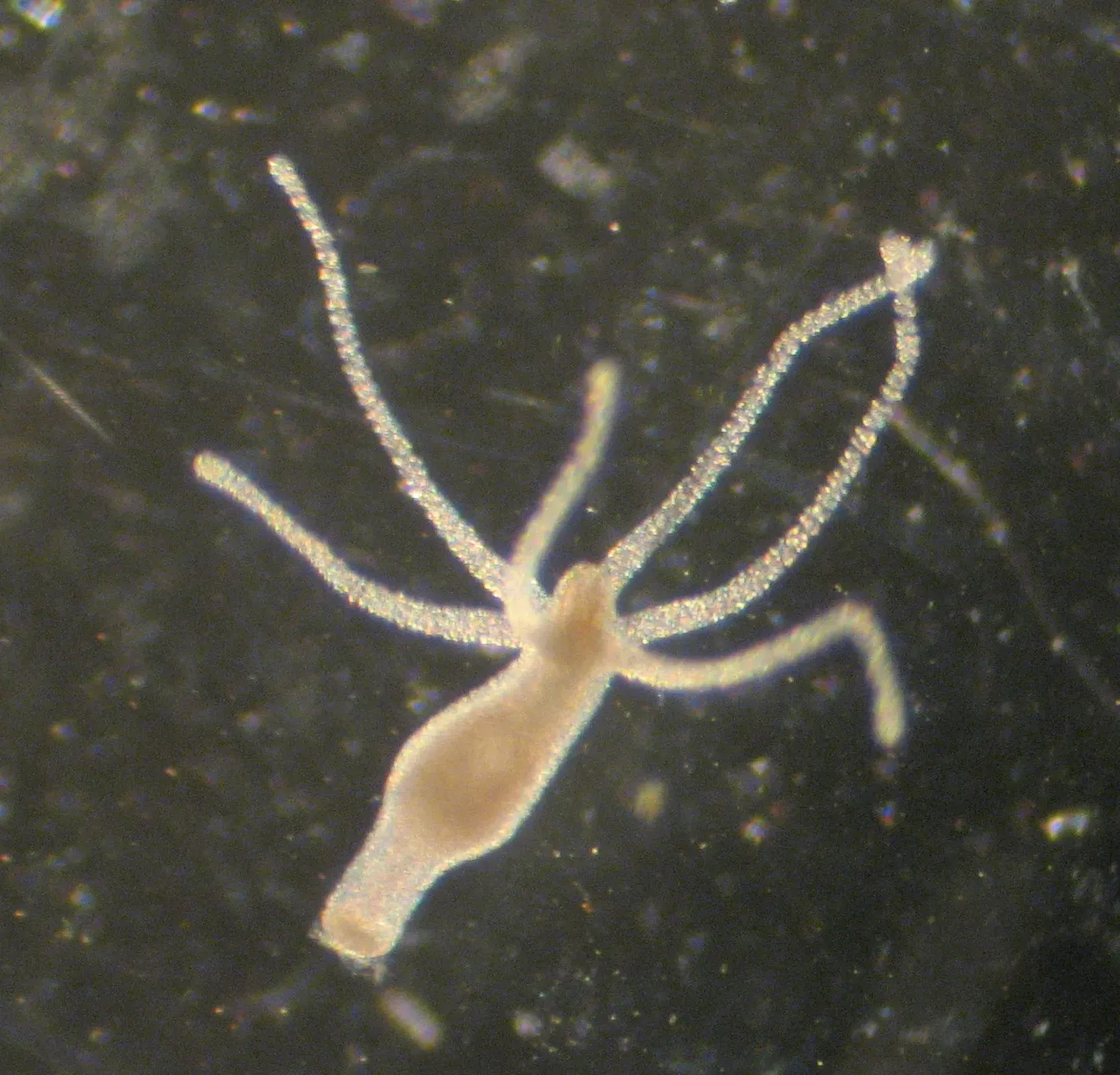
The hydra is a tiny pond animal, so small that it is only about the length of a grain of rice — sometimes even tinier. Its body is a slim, see-through tube. At one end it sticks to a leaf or a stone like a little suction cup, and at the other end it opens into a crown of waving tentacles.
Those tentacles are how a hydra catches its dinner. Hydras look gentle, but they are hunters, snapping up water fleas and other tiny creatures that drift too close. Each tentacle is dotted with special stinging cells that shoot out to hold onto passing food. Then the tentacles pull the meal right into the hydra’s mouth.
Here is the most amazing thing of all: a hydra can regrow itself. If a hydra is cut into pieces, each piece can grow into a whole new hydra, tentacles and all. It is almost like magic! Because of this, scientists love to study hydras to learn how bodies heal and how living things fix themselves.
Hydras also make babies in a clever way called budding. A tiny bump grows on the side of the parent, slowly forms its own little tentacles, and then breaks off to drift away as a brand-new hydra. When the pond is warm and there is plenty of food, a single hydra can grow lots of little buds.
Some scientists even wonder whether hydras might not grow old the way other animals do, staying fresh and young year after year. Not everyone agrees, and it is still a puzzle they are studying. Either way, this simple little tube, no bigger than a rice grain, is one of the small wonders hiding in a pond.
My home
Pond, lake, slow stream
Where I live
Asia, Europe, North America
What I eat
Water fleas, tiny crustaceans, small pond animals
How long I am
0.01–0.03 m
A hydra catches its food with a ring of thin tentacles dotted with tiny stinging cells, which shoot out to grab passing water fleas and other tiny creatures.
If a hydra is cut into pieces, each piece can grow into a whole new hydra, tentacles and all — almost like magic!
Some scientists think hydras might not grow old the way other animals do, but this idea is still debated and not everyone agrees.
Every freshwater hydra can feel happy, scared and loved — just like you.
Looking after my friends
Not checked yetNo one has counted them carefully yet.
You can help by learning their names, keeping wild places clean, and telling someone why this animal matters.
Where this came from
- Hydra vulgaris — Red List status — IUCN Red List of Threatened Species
- Model systems for regeneration: Hydra — Development (The Company of Biologists)
- Hydra vulgaris — Wikipedia