 Real photograph
 Fire Salamander
Salamandra salamandra
say it sal-uh-MAN-druh sal-uh-MAN-druh
Why we love them
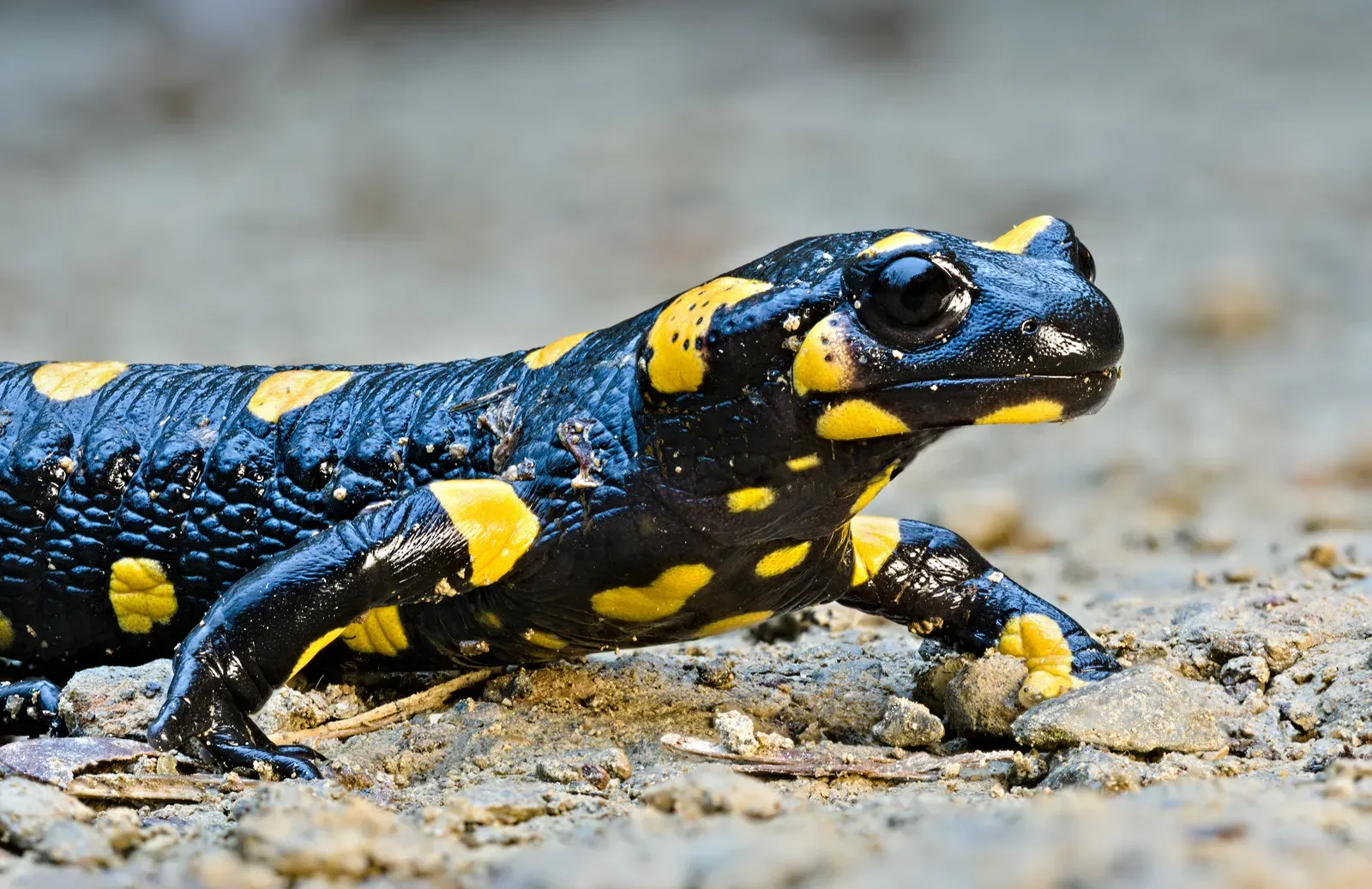
The fire salamander is a small amphibian with beautiful shiny skin that is deep black with bright splashes of yellow. Sometimes the yellow looks like spots and sometimes like stripes, and every salamander has its own special pattern. It lives in the cool, leafy forests of Europe, especially in hilly places.
Those bright colours are not just for show. They are a warning. The fire salamander’s skin makes a special liquid that tastes horrible and is poisonous, so most animals learn to leave it well alone. This is a clever, calm way for a slow little animal to stay safe without having to run or fight. It is best simply to look and never to touch.
Fire salamanders like damp, shady places. They spend much of the day hidden under logs, stones, and fallen leaves, and they come out in the evening and at night to hunt. On rainy days they may wander about in the daytime too. They eat small creatures such as insects, spiders, earthworms, and slugs, catching them with a quick flick.
These salamanders need clean water nearby. Most mother fire salamanders do not lay eggs on land. Instead they give birth to tiny swimming babies, called larvae, in a cool stream or pond. The larvae breathe underwater with feathery gills until they grow legs and are ready to come out onto the land.
Fire salamanders are still found across much of Europe, so as a whole they are doing all right. But in some places they are in trouble because of a new skin disease caused by a fungus, and because the clean forests and streams they need are sometimes damaged. People are watching over them carefully and protecting their woodland homes so they can keep thriving.
My home
Deciduous forest, woodland, near fresh water
Where I live
Europe
What I eat
Insects, spiders, earthworms, slugs, millipedes
How long I am
0.15–0.25 m
How long I live
50 years
The fire salamander's bright yellow-and-black pattern is a warning sign. It tells hungry animals that its skin makes a nasty-tasting poison, so it is best to leave it alone.
Fire salamanders can live a very long time. Some have reached about fifty years old, which makes them one of the longest-living amphibians.
Instead of laying eggs on land, mother fire salamanders usually give birth to little swimming babies, called larvae, straight into a cool, clean stream or pond.
Every fire salamander can feel happy, scared and loved — just like you.
Looking after my friends
Doing wellThere are lots of these animals in the wild right now. That is good news!
You can help by learning their names, keeping wild places clean, and telling someone why this animal matters.
Where this came from
- Salamandra salamandra (Fire Salamander) — Red List Assessment — IUCN Red List of Threatened Species
- Salamandra salamandra (fire salamander) — Animal Diversity Web, University of Michigan Museum of Zoology
- Fire salamander — Wikipedia (English)