 Real photograph
 Crown-of-thorns starfish
Acanthaster planci
say it KROWN-of-THORNZ STAR-fish
Why we love them
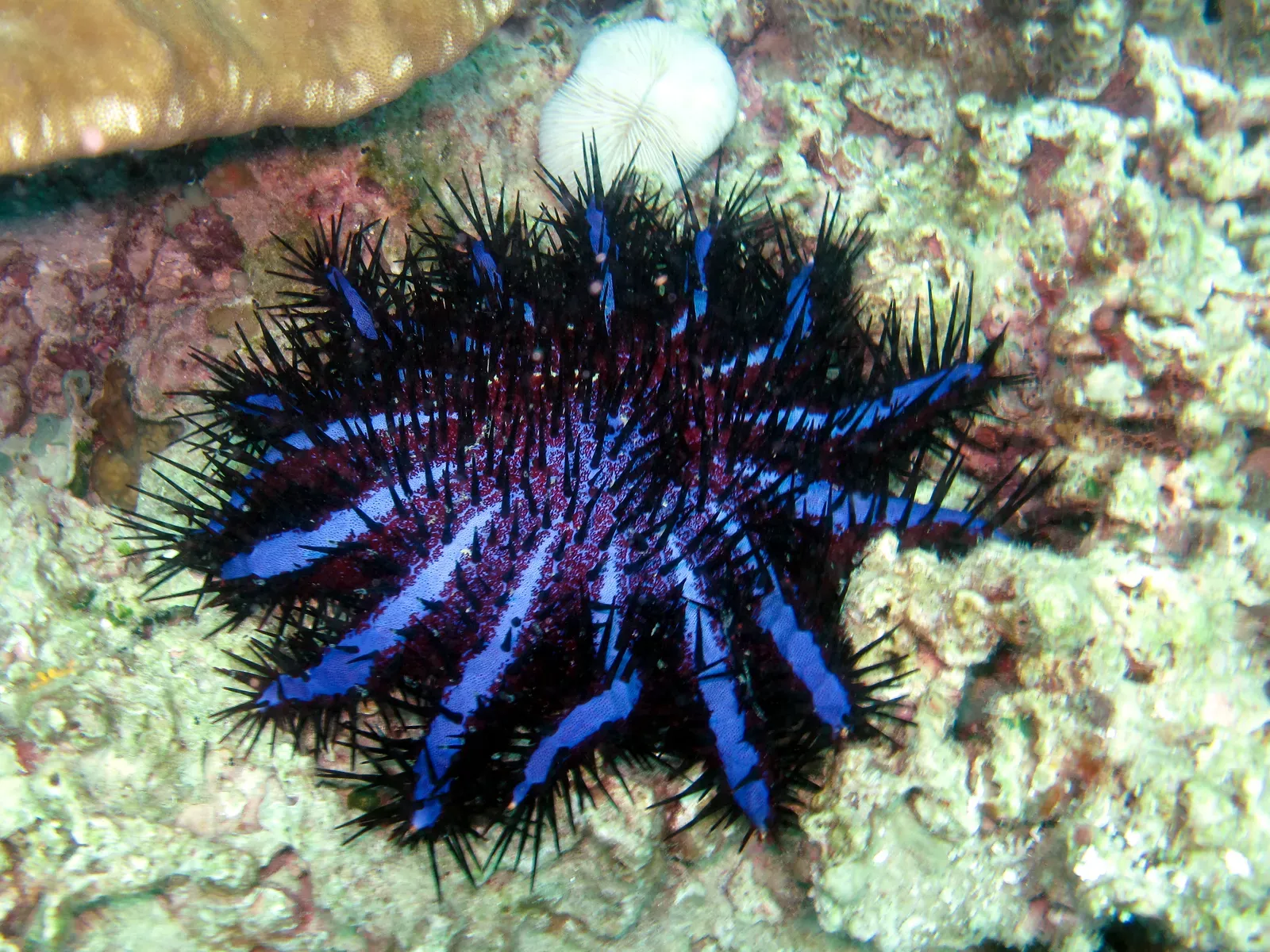
The crown-of-thorns starfish is a big, spiky sea star that lives on warm coral reefs. It has a round middle and many arms spreading out, all covered in long, sharp spines. It is one of the largest starfish in the whole world, and it can grow as wide as a beach ball or more.
Those spines are not just for show. They carry a mild sting, so most animals leave the starfish alone. A few reef creatures, like the giant triton snail and some big fish, are still brave enough to eat one.
The crown-of-thorns has an unusual way of eating. It climbs onto a piece of coral and pushes its stomach right out through its mouth, spreading it over the coral to soak up the soft parts inside. When it moves on, it leaves a clean white patch behind.
This starfish is a natural part of the reef, and in small numbers it has always lived there. Sometimes, though, huge crowds of them appear at once. When that happens they can eat so much coral that the reef needs a long time to grow back, so reef scientists keep a careful eye on their numbers.
The crown-of-thorns starfish is not a monster — it is simply doing what it was born to do. It reminds us that a healthy reef needs all of its animals to stay in balance, the spiky ones as well as the pretty ones.
My home
Coral reef, ocean
Where I live
Pacific Ocean, Indian Ocean
What I eat
Stony coral polyps
How long I am
1 m
A crown-of-thorns starfish has many arms and is covered in sharp, stinging spines.
It eats coral by pushing its stomach out of its body and resting it over the coral.
It is one of the biggest starfish in the whole world.
Every crown-of-thorns starfish can feel happy, scared and loved — just like you.
Looking after my friends
Not checked yetNo one has counted them carefully yet.
You can help by learning their names, keeping wild places clean, and telling someone why this animal matters.
Where this came from
- Crown-of-thorns starfish — Great Barrier Reef Foundation — Great Barrier Reef Foundation
- Crown-of-thorns starfish — Wikipedia — Wikipedia