 Real photograph
 Common hermit crab
Pagurus bernhardus
say it KOM-un HUR-mit krab
Why we love them
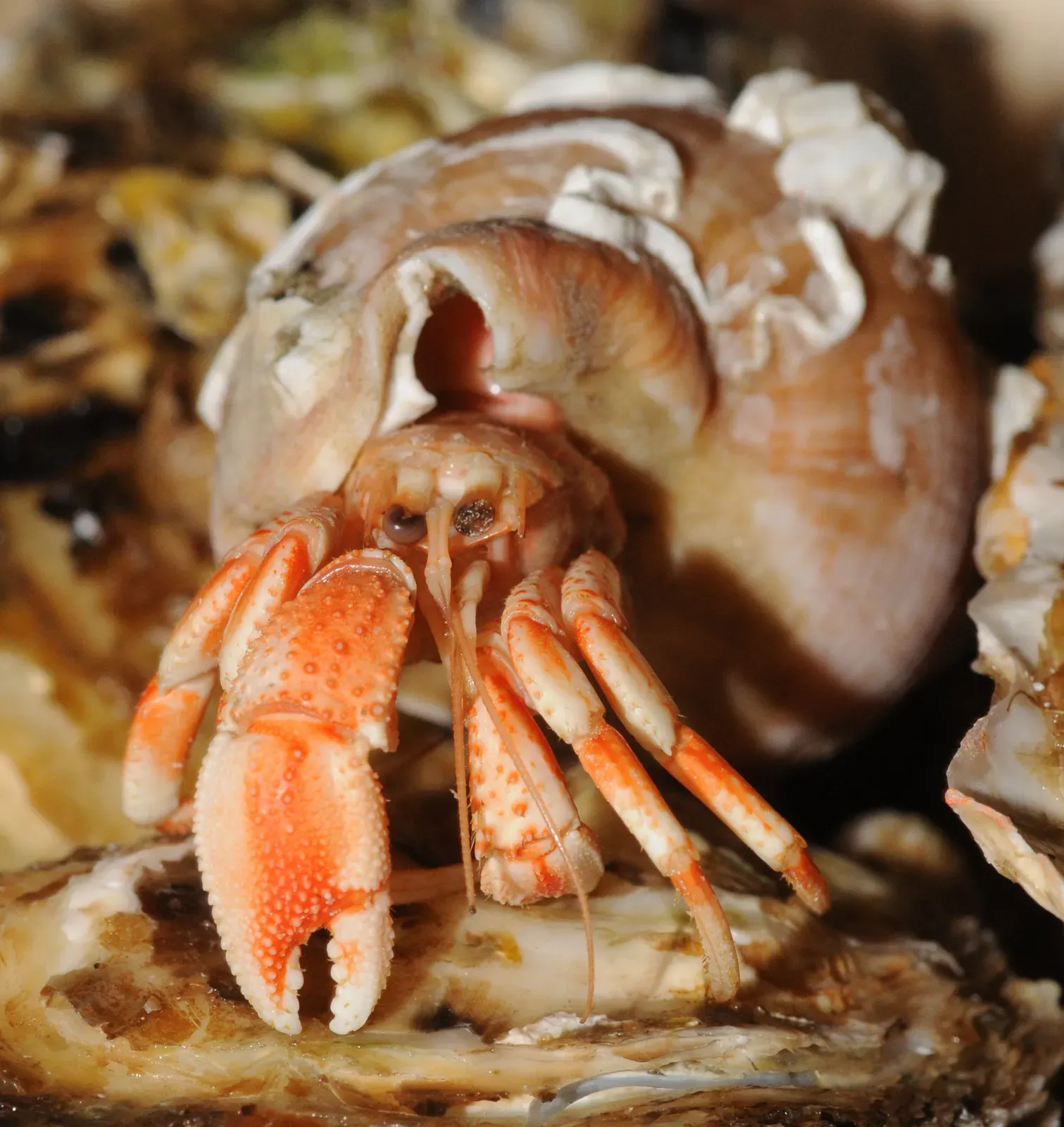
The common hermit crab is one of the sea’s most lovable recyclers. Unlike most crabs, its curly tail is soft instead of hard, so it needs somewhere snug to keep it safe. Its clever answer is to borrow an empty snail shell and wear it like a cosy home, carrying it everywhere it goes. You will find these reddish little crabs in rock pools and on sandy seabeds around Europe’s Atlantic coast.
The trouble with a borrowed home is that the crab keeps growing, and one day its shell becomes too tight. So the hermit crab goes house-hunting. It finds a bigger empty shell, checks it over carefully, then quickly tucks its soft tail inside. Old shells left behind by periwinkles and whelks make perfect new homes for the crab as it gets larger.
At the front, a hermit crab has two pincers, and the right one is much bigger than the left. When something worrying comes near, the crab pulls itself deep inside its shell and blocks the doorway with that big claw, like shutting a front door. Its pincers also help it pick up food and clamber over rocks and gravel on the seabed.
This little crab is not fussy about dinner. It is an omnivore that scavenges worms, tiny shellfish, seaweed and scraps left on the seabed, day and night. By eating up leftovers, it helps keep its underwater world clean and tidy. Hermit crabs shuffle busily across the bottom of the sea, always sniffing out where their next meal might be hiding.
Sometimes a hermit crab shares its shell with a special guest. A sea anemone may settle on top, riding along like a gentle passenger. The anemone’s waving arms help keep the crab safe, and in return it catches drifting scraps of the crab’s food. The two live together as friendly neighbours, quietly helping each other out as they travel the seabed.
My home
Rocky shore, tide pool, sandy seabed, coastal waters
Where I live
Europe, Atlantic Ocean
What I eat
Worms, small shellfish, algae, detritus, carrion
How long I am
0.035 m
The common hermit crab does not grow its own hard shell — it borrows an empty snail shell to protect its soft, curly tail.
As it grows too big for its home, the hermit crab swaps to a roomier empty shell, such as a periwinkle or a whelk.
Sometimes a sea anemone rides along on top of a hermit crab's shell, and the two live together as helpful neighbours.
Every common hermit crab can feel happy, scared and loved — just like you.
Looking after my friends
Not checked yetNo one has counted them carefully yet.
You can help by learning their names, keeping wild places clean, and telling someone why this animal matters.
Where this came from
- Pagurus bernhardus — IUCN Red List status check — IUCN Red List of Threatened Species
- Bernhard's hermit crab (Pagurus bernhardus) — MarLIN — The Marine Life Information Network (Marine Biological Association)
- Pagurus bernhardus — Wikipedia