Today's animal friend · 14 July 2026
Red Kangaroo: The Evening Hopper of Australia’s Open Country
Across Australia’s dry grasslands, scrublands, deserts, and plains, red kangaroos wait out the hottest hours and emerge in the soft light of evening. Their story is one of springy leaps, careful parenting, and a life closely tuned to plants
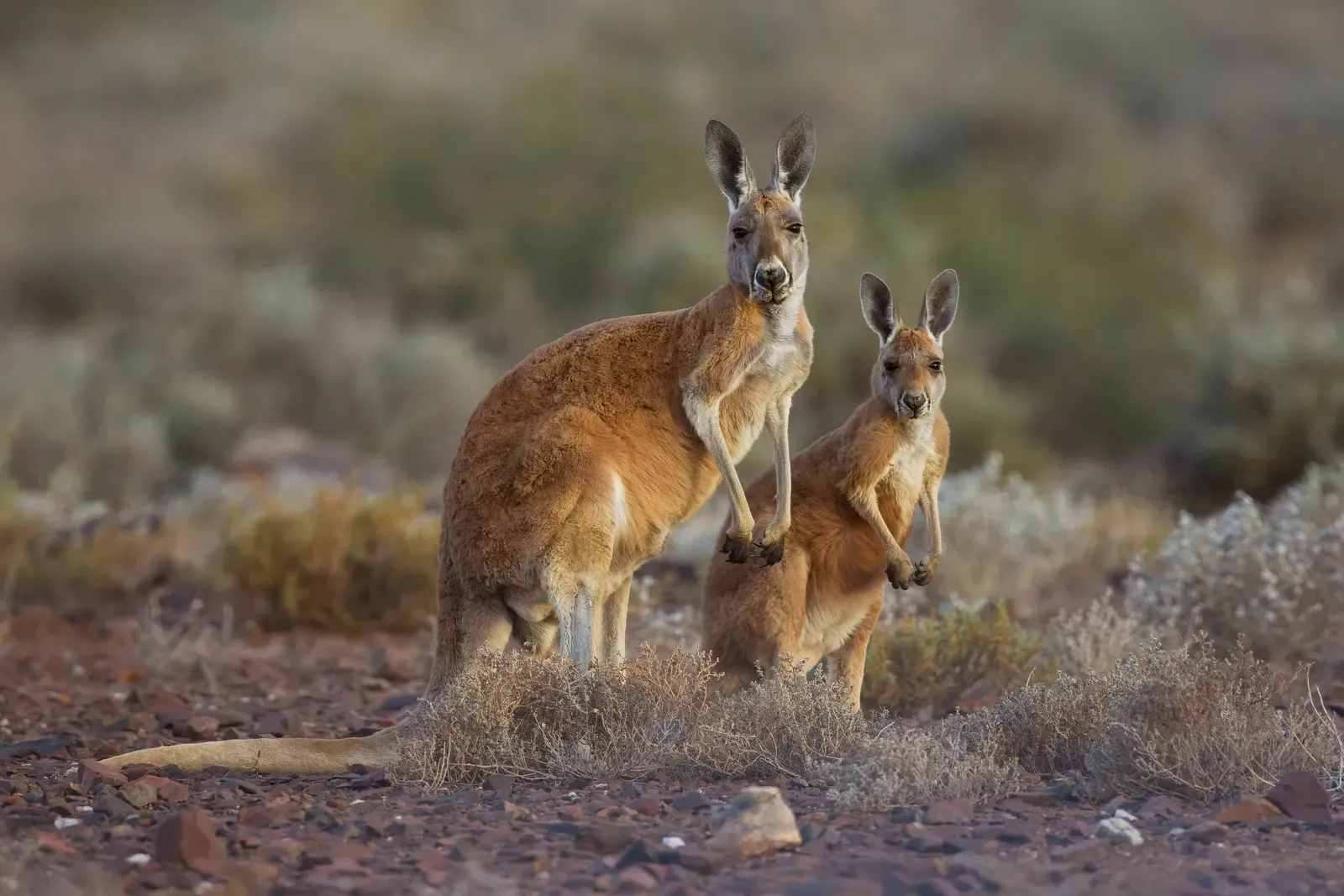
Across Australia’s dry grasslands, scrublands, deserts, and plains, red kangaroos wait out the hottest hours and emerge in the soft light of evening. Their story is one of springy leaps, careful parenting, and a life closely tuned to plants
A red kangaroo is a giant among pouch-carrying animals
The red kangaroo, or Osphranter rufus, is the biggest marsupial in the world. Marsupials are mammals whose young continue developing in a pouch after birth. That makes a red kangaroo both wonderfully familiar—a mammal with fur, ears, and a devoted mother—and completely extraordinary. Imagine an animal that may stand taller than a grown-up person, then picture its tiny newborn starting life no bigger than a jellybean.
Red kangaroos belong to the kangaroo family, Macropodidae, and live on the Australian continent in Oceania. There is plenty of variety among individuals. Head-and-body length is reported at roughly 0.75 to 1.4 metres, while large males may stand about 1.5 to 1.8 metres tall. Females can weigh around 18 to 35 kilograms; the largest males can reach about 85 to 90 kilograms. Those broad ranges remind us that every animal is an individual, not simply a set of measurements.
Their name gives a clue to one common look: big males are often richly reddish. Yet red kangaroos do not all look identical, and females are commonly smaller and may appear blue-grey. Whether glowing rusty red or shaded grey, each has the same unmistakable outline: alert ears, strong hind legs, small front paws, and a long, sturdy tail.
Evidence: IUCN Red List of Threatened Species: Osphranter rufus (Red Kangaroo) — Red List Assessment; Australian Museum: Red Kangaroo (Osphranter rufus); San Diego Zoo Wildlife Alliance: Kangaroo and Wallaby
Their home is open country where shade matters
Red kangaroos are animals of wide horizons. They live in grassland, desert, scrubland, and dry plains—open places where the day can become fiercely hot and a patch of shade can feel like a treasure. The landscape is not empty just because it is dry. It holds grasses, herbs, leaves, and many small signs of life, from changing light to the rustle of plants in the breeze.
A red kangaroo’s daily rhythm fits this setting. It is especially active at twilight and at night. During the brightest, hottest part of the day, resting in shade is a sensible way to avoid the heat; when evening cools the ground, feeding becomes more comfortable. Think of dusk as the beginning of its busy time, not the end of its day.
Like many wild animals, red kangaroos live with changing conditions. Drought and habitat change are among the pressures noted for the species. The IUCN assessment lists the red kangaroo as Least Concern, with a stable population trend, which is encouraging. Still, “Least Concern” is not an invitation to stop caring. It is a reason to keep paying attention to the dry-country homes that kangaroos depend on.
Evidence: IUCN Red List of Threatened Species: Osphranter rufus (Red Kangaroo) — Red List Assessment; Australian Museum: Red Kangaroo (Osphranter rufus); San Diego Zoo Wildlife Alliance: Kangaroo and Wallaby
Hopping is their spectacular way of travelling
When a red kangaroo moves across open ground, it does not walk like a dog, deer, or person. It hops. Its large hind legs provide the power for this springing journey, and its long tail helps it balance. The result can look almost effortless: a sequence of buoyant bounds carrying a large animal steadily onward.
Red kangaroos can hop at around 50 kilometres per hour. That is why a description comparing their speed with a car travelling through town feels so vivid. They can also cover a great distance in a single bound, although exact leap measurements vary. The important picture is clear: the red kangaroo is made for crossing open country with impressive speed and reach.
The tail is more than an elegant finishing line to the animal’s silhouette. It is part of the kangaroo’s balancing equipment, useful as the body shifts and lands. Watching a kangaroo hop can inspire a good question: how many different ways can bodies solve the challenge of getting from one place to another? Wings, fins, paws, and springing legs all tell different stories.
Evidence: Australian Museum: Red Kangaroo (Osphranter rufus); San Diego Zoo Wildlife Alliance: Kangaroo and Wallaby
A joey’s first climb is a brave beginning
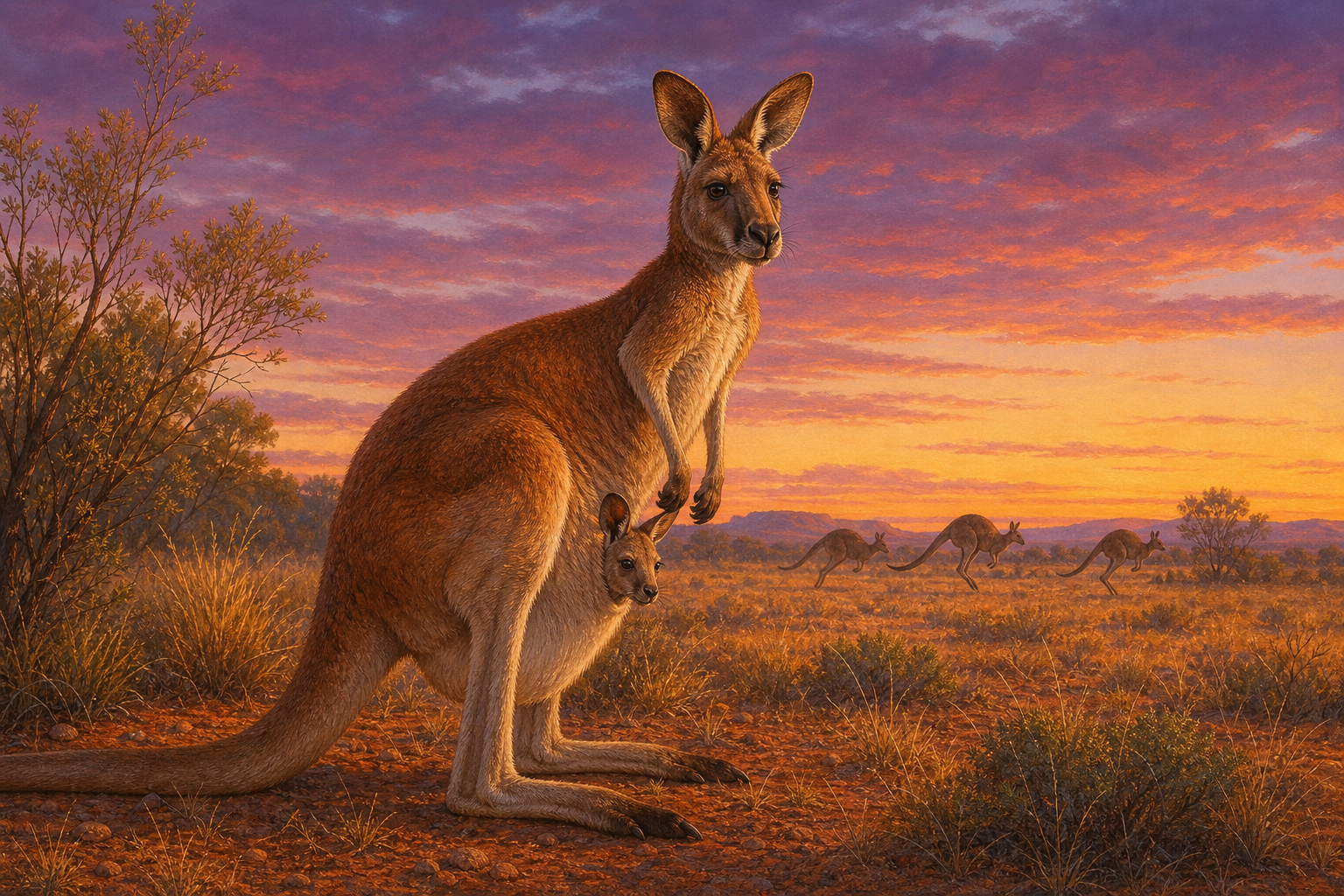
The beginning of a red kangaroo’s life is astonishingly small. A newborn joey is only about 2 to 3 centimetres long—often compared with a jellybean. It is born at a stage when it needs the safety of its mother’s pouch to keep growing. The tiny joey climbs to that pouch, where it drinks milk and develops over many months.
This is not a miniature version of an adult bounding across the plain. It is a vulnerable young animal making an urgent journey to warmth, nourishment, and shelter. The pouch is a temporary nursery carried with its mother. Later, as the joey grows, it becomes ready for more of the world beyond it.
That close beginning offers a gentle reminder that wild families matter. A kangaroo mother is not a symbol or a landscape decoration; she is an individual caring for her young in a demanding environment. Seeing animals this way can change the way we look at every creature nearby, from a bird feeding its chicks to a rabbit sheltering its babies.
Evidence: Australian Museum: Red Kangaroo (Osphranter rufus); San Diego Zoo Wildlife Alliance: Kangaroo and Wallaby
The menu is made of plants
Red kangaroos are herbivores. Their meals include grasses, herbs, leaves, and other green plants. In their dry habitats, finding enough suitable food is part of the daily adventure. As evening arrives, a kangaroo can feed among the vegetation, choosing from the plant life available across the open country.
A plant-eating life is a useful invitation to notice how connected a habitat is. Healthy grasslands and scrublands are not merely scenery behind an animal; they are the living pantry that supports it. When we care about a red kangaroo, we are also caring about the plants, soil, water, and space that make its life possible.
For people, it can be joyful to let this idea inspire a meal now and then: colourful vegetables, fruit, beans and other pulses, whole grains, nuts, and seeds can make a varied plate. The World Health Organization includes these foods in general healthy-diet guidance. Food needs differ from person to person, so children should make any bigger food changes with a trusted adult and, when needed, a qualified health professional.
Evidence: Australian Museum: Red Kangaroo (Osphranter rufus); San Diego Zoo Wildlife Alliance: Kangaroo and Wallaby; World Health Organization: Healthy diet
A hopeful future begins with noticing who shares the world
The red kangaroo has a stable population trend in its 2016 IUCN assessment, and that is heartening news. It means there are still many chances for people to learn from this remarkable marsupial: its patience through hot days, its remarkable motion at dusk, and the tender pouch-bound start of every joey.
Caring does not have to begin with a grand gesture. It can begin by learning an animal’s real name, remembering that it has a home, and choosing curiosity over carelessness. The more clearly we see animals as fellow lives rather than things, the more naturally kindness enters our choices.
Red kangaroos are champions of their own landscape, not characters built for our entertainment. Their lives unfold in the cool evening, among the grasses and dry plains of Australia. Our job, even from far away, can be to admire them responsibly and make room in our imagination for the wild lives that are not ours to use.
Evidence: IUCN Red List of Threatened Species: Osphranter rufus (Red Kangaroo) — Red List Assessment; Australian Museum: Red Kangaroo (Osphranter rufus); San Diego Zoo Wildlife Alliance: Kangaroo and Wallaby
A kind choice can reach beyond our own table
A red kangaroo’s life depends on plants and on a living landscape. We can carry that thought into our own choices with gentleness: trying more satisfying plant-based meals is one way to practise kindness toward animals while enjoying food from the plant world. A bright bean stew, a vegetable wrap, or fruit and whole grains can be an exploration, not a rule or a test.
The World Health Organization’s general guidance highlights varied diets with whole grains, vegetables, fruit, pulses, nuts, and seeds. The IPCC reports that shifts toward sustainable, healthy, more plant-based diets can help reduce food-system emissions and pressure on land and biodiversity. For a young animal friend, that connection is simple and hopeful: choosing plants more often can be a small way of saying that other animals and their homes matter too.
Every family’s circumstances and food needs are different. Be curious, be kind, and talk with a trusted adult about meals. The aim is not perfection; it is learning to make room for compassion—one thoughtful choice at a time.
Evidence: World Health Organization: Healthy diet; Intergovernmental Panel on Climate Change: Climate Change 2022: Mitigation of Climate Change — Chapter 7
Questions people ask
Where do red kangaroos live?
They live in Australia, especially in open dry habitats including grassland, desert, scrubland, and dry plains.
Evidence: IUCN Red List of Threatened Species: Osphranter rufus (Red Kangaroo) — Red List Assessment; Australian Museum: Red Kangaroo (Osphranter rufus); San Diego Zoo Wildlife Alliance: Kangaroo and Wallaby
Why do red kangaroos come out in the evening?
They are active mainly at twilight and at night. Resting during the hottest part of the day helps them cope with hot, dry conditions.
Evidence: Australian Museum: Red Kangaroo (Osphranter rufus); San Diego Zoo Wildlife Alliance: Kangaroo and Wallaby
What does a red kangaroo eat?
It is a herbivore, eating grasses, herbs, leaves, and other green plants.
Evidence: Australian Museum: Red Kangaroo (Osphranter rufus); San Diego Zoo Wildlife Alliance: Kangaroo and Wallaby
How small is a newborn red kangaroo?
A newborn joey is about 2 to 3 centimetres long, often described as jellybean-sized, and climbs into its mother’s pouch to continue growing.
Evidence: Australian Museum: Red Kangaroo (Osphranter rufus)
Are red kangaroos endangered?
The IUCN lists the red kangaroo as Least Concern in its 2016 assessment, with a stable population trend. Drought and habitat change still matter for the species and its home.
Evidence: IUCN Red List of Threatened Species: Osphranter rufus (Red Kangaroo) — Red List Assessment
Read the evidence
Sources behind this story
- Osphranter rufus (Red Kangaroo) — Red List Assessment — IUCN Red List of Threatened Species
- Red Kangaroo (Osphranter rufus) — Australian Museum
- Kangaroo and Wallaby — San Diego Zoo Wildlife Alliance
- Healthy diet — World Health Organization
- Climate Change 2022: Mitigation of Climate Change — Chapter 7 — Intergovernmental Panel on Climate Change
Health information is general education, not personal medical advice. Young readers should make food choices with a trusted adult and qualified health professional.