Today's animal friend · 20 July 2026
Raccoon: The Masked Night Neighbour with Remarkable Paws
A raccoon may look as if it is heading to a costume party in a dark eye mask, but this familiar animal is a thoughtful explorer with an extraordinary sense of touch. Follow its pawprints from moonlit riverbanks to city gardens—and discover
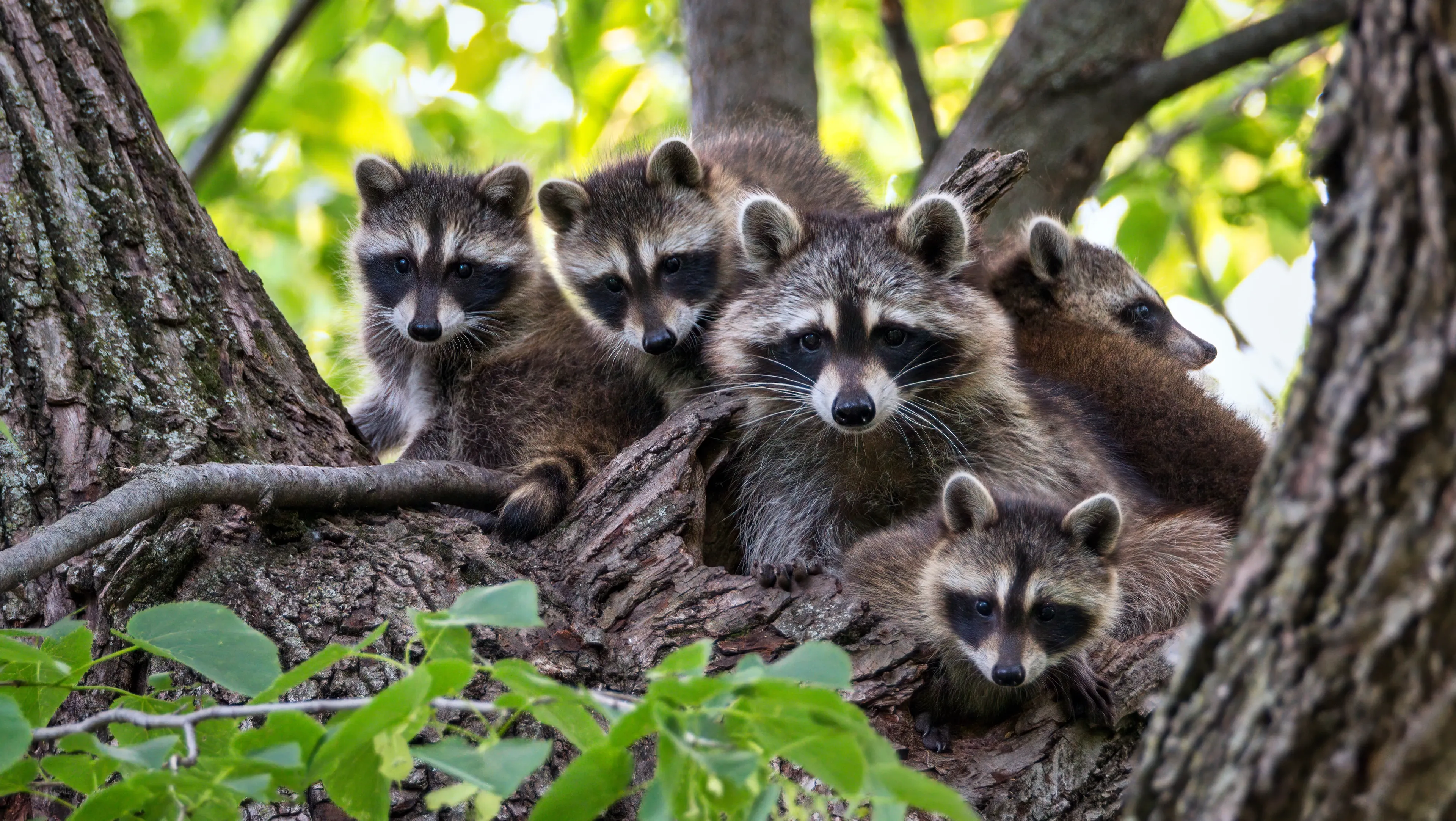
A raccoon may look as if it is heading to a costume party in a dark eye mask, but this familiar animal is a thoughtful explorer with an extraordinary sense of touch. Follow its pawprints from moonlit riverbanks to city gardens—and discover
A raccoon is easy to recognise—even in the dusk
The raccoon, or Procyon lotor, is sometimes called the northern raccoon or common raccoon. It is a mammal in the family Procyonidae, and its face is one of the most recognisable in the animal world: dark fur sweeps across the eyes like a mask. Behind it trails a bushy tail marked with dark rings. Put those two features together and you have a splendid silhouette for a storybook—but this is no make-believe creature.
Raccoons range from about 0.6 to 1.1 metres in total length, including the tail, and stand roughly 23 to 30 centimetres at the shoulder. Their weight varies greatly too. Rather than trying to judge one by a quick glimpse in the shadows, it is better to notice the clues they leave: a watchful face, a low sturdy body, nimble front paws, and a ringed tail disappearing around a tree or beneath a hedge.
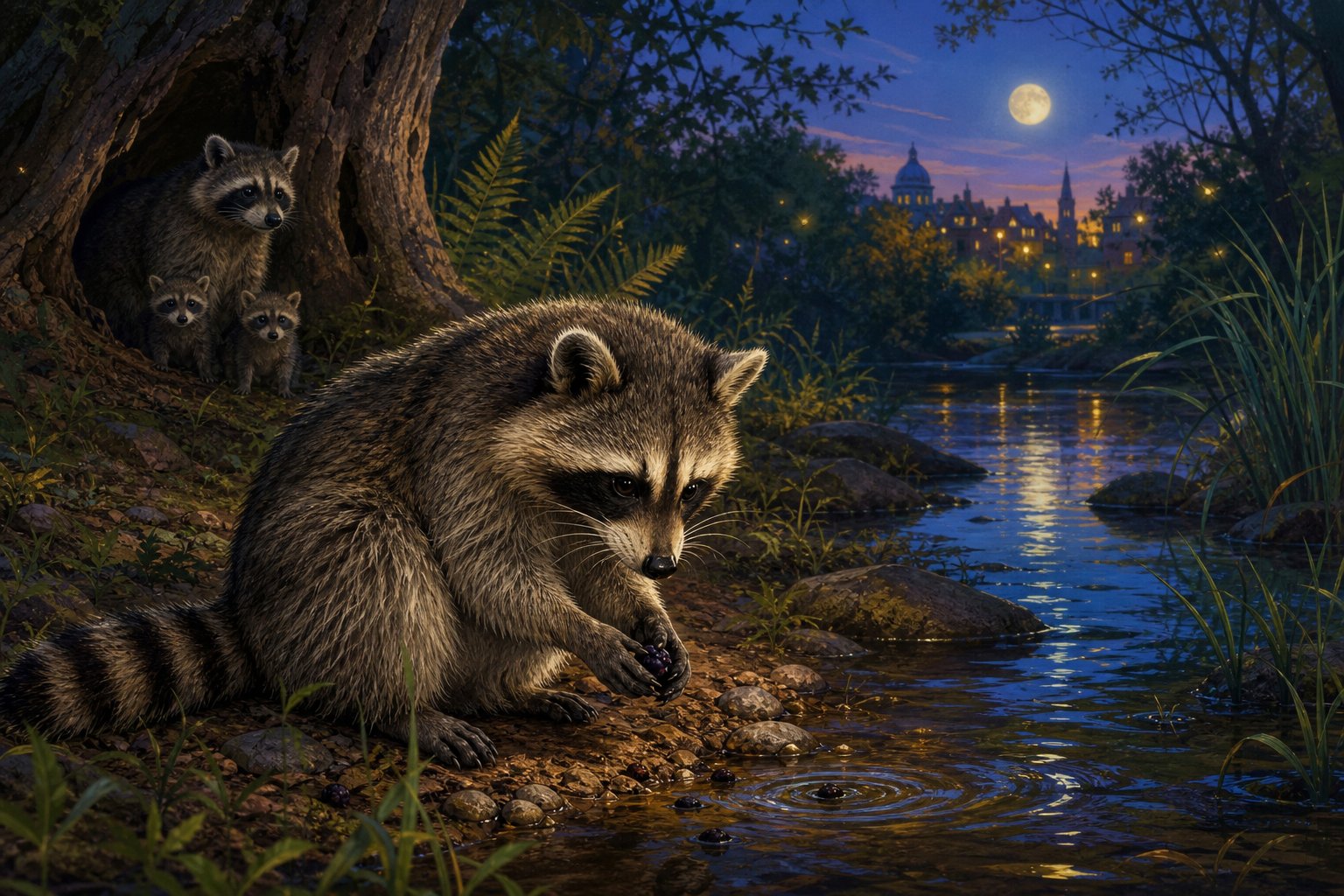
Their scientific name offers a small clue to one of their most famous habits. The word lotor means “washer.” Yet a raccoon is not doing the dishes when it handles food near water. It is exploring with touch. Wet paws can become especially sensitive, helping the animal feel what it is holding and sort a tempting morsel from something it does not want.
Evidence: IUCN Red List of Threatened Species: Procyon lotor (Raccoon) — Red List Assessment; Animal Diversity Web, University of Michigan Museum of Zoology: Procyon lotor (northern raccoon); Wikipedia: Raccoon (Procyon lotor)
Those front paws are a raccoon’s super-sensory tools
A raccoon’s front paws have five long, flexible fingers. They work almost like little hands, allowing the animal to feel, grasp, turn, and investigate objects closely. Imagine trying to understand a place largely through your fingertips: the cool smoothness of a pebble, the bumpy shell of a crayfish, the soft skin of a fruit, or the watery edge of a riverbank. For a raccoon, touch is a major part of discovery.
That is why the familiar dipping-and-rubbing behaviour is so fascinating. Near water, a raccoon may dip food and rub it between its paws before eating. It is not evidence that raccoons are fussy or playful in the human sense; it is a practical way to gather information through sensitive paws. The animal’s alert nose, eyes, ears, and hands-like paws together make it a skilled nighttime forager.
This cleverness should inspire respect, not an invitation to get close. Wild animals do best when they can make their own decisions and find their own food. Watching quietly from a distance, without offering snacks or trying to touch one, gives a raccoon space to remain a raccoon.
Evidence: Animal Diversity Web, University of Michigan Museum of Zoology: Procyon lotor (northern raccoon); Wikipedia: Raccoon (Procyon lotor)
Raccoons make homes wherever water, cover, and opportunity meet
Raccoons are native across much of North America, from southern Canada through the United States and into northern South America. They now also occur in parts of Europe and Asia after being introduced there. Their wide distribution is a reminder that an animal’s story can change when it is moved beyond its native range, so it is important never to release animals or treat wildlife as a casual pet project.
In their native landscapes, raccoons often favour moist woodland with easy access to water. Wetlands and riverbanks offer places to search for food, while trees and sheltered spaces can provide den sites. But raccoons are highly adaptable. They also live around farmland, suburbs, and towns. A neighbourhood at twilight can contain more wild life than people notice: rustling leaves, a brief shape on a fence, and a pair of eyes reflecting a porch light before vanishing into the night.
Dens may be in trees, burrows, caves, buildings, or other protected spaces. In spring, a mother usually has one litter, often about four babies called kits. The young are cared for by their mother in a den and later begin following her out to explore. Outside mother-and-young groups, raccoons are mainly solitary. That makes a kit’s early months with its mother especially important: they are a time for shelter, learning, and staying close.
Evidence: Animal Diversity Web, University of Michigan Museum of Zoology: Procyon lotor (northern raccoon); Wikipedia: Raccoon (Procyon lotor); IUCN Red List of Threatened Species: Procyon lotor (Raccoon) — Red List Assessment
What does a raccoon eat? A changing menu for an omnivore
Raccoons are omnivores, meaning their food can include both plant and animal matter. Their menu may feature fruit, nuts, insects, crayfish, eggs, and small animals. What is available depends on season and place. A woodland, wetland, or town park does not offer the same choices every day, and a raccoon is well equipped to investigate what its home provides.
This flexible diet helps explain why raccoons can live in many kinds of habitat. Plant matter can be an important part of their food in some places, while aquatic edges can offer crayfish and other small creatures. As foragers, raccoons can affect the local animals they eat; they are also prey themselves for animals including coyotes, wolves, and large hawks and owls.
For people, the kindest response to a hungry-looking wild neighbour is not a handout. Food left for raccoons can encourage them to rely on people and return too closely to homes. Instead, keep a respectful distance and let wild animals do the searching, choosing, and living that their own bodies and senses are built for.
Evidence: Animal Diversity Web, University of Michigan Museum of Zoology: Procyon lotor (northern raccoon); Wikipedia: Raccoon (Procyon lotor)
The real raccoon adventure begins after sunset
Raccoons are mostly nocturnal, which means they are chiefly active at night; they may also be active around twilight. Darkness is not empty for them. It is a world of scent trails, soft footsteps, water sounds, bark textures, and careful paw-led investigations. Their ability to climb and swim expands the places they can travel and the foods they can find.
If you want to be a considerate raccoon detective, look without disturbing. A respectful evening walk with an adult might reveal signs rather than an actual animal: a movement high in a tree, a shape crossing a quiet path, or tracks near a muddy bank. Never follow closely, corner an animal, or reach into a den. A den is a private safe place, especially when kits may be inside.
Coexistence can be wonderfully ordinary. Keep household waste secure, do not leave food outside for wildlife, and give a raccoon a clear route away if you spot one. These choices are not about making a raccoon less interesting. They are about allowing an alert, independent animal to stay wild while sharing a landscape with people.
Evidence: Animal Diversity Web, University of Michigan Museum of Zoology: Procyon lotor (northern raccoon); Wikipedia: Raccoon (Procyon lotor)
A hopeful picture, with room for care
The raccoon is listed by the IUCN as Least Concern, based on a 2016 assessment, and its overall population trend is described as increasing. Mainland populations have grown and expanded as raccoons have adapted to human-shaped landscapes. This is welcome news for the species at a global level: the masked night explorer is widespread and abundant across much of its range.
“Least Concern” does not mean that every individual raccoon has an easy life, or that people can stop being thoughtful. Local animals can be harmed by vehicles, trapping, hunting, and disease. Thoughtful towns and households can reduce unnecessary conflict by avoiding hand-feeding and keeping spaces safer and tidier for both people and wildlife.
There is also an important naming note for curious animal friends: the widespread mainland raccoon, Procyon lotor, should not be confused with separate island raccoon forms that have had different histories. Conservation stories are often most useful when we ask, “Which animal, in which place?” Careful attention keeps a broad, hopeful global picture from hiding local challenges.
Evidence: IUCN Red List of Threatened Species: Procyon lotor (Raccoon) — Red List Assessment; Animal Diversity Web, University of Michigan Museum of Zoology: Procyon lotor (northern raccoon); Wikipedia: Raccoon (Procyon lotor)
A kind choice can begin with curiosity—and a plant-filled plate
A raccoon’s busy life is a gentle reminder that every animal is someone with a home, preferences, and a reason to be left in peace. We can practise that respect nearby: admire wildlife from a distance, avoid feeding wild animals, and make room for them to travel safely through the places we share.
Kindness can stretch beyond the garden gate. When families plan meals, colourful plant foods—whole grains, vegetables, fruit, pulses, nuts, and seeds—can be delicious ways to celebrate the living world without treating animals as ingredients. The World Health Organization describes these foods as part of varied healthy diets, while the IPCC reports that shifts toward sustainable, healthy, more plant-based diets can reduce pressure from food systems on the climate, land, and biodiversity.
No one has to be perfect to be compassionate. Perhaps try a bean-filled taco night, a lentil soup, fruit with oats, or a favourite vegetable meal, and share the idea with a trusted adult. Small, cheerful choices can say something important: wild raccoons belong on moonlit paths, using their remarkable paws to choose their own supper.
Evidence: Animal Diversity Web, University of Michigan Museum of Zoology: Procyon lotor (northern raccoon); World Health Organization: Healthy diet; Intergovernmental Panel on Climate Change: Climate Change 2022: Mitigation of Climate Change — Chapter 7
Questions people ask
Why do raccoons put food in water?
They may dip and rub food between their paws because wet paws can be especially sensitive to touch. This helps a raccoon investigate what it is holding before eating.
Evidence: Wikipedia: Raccoon (Procyon lotor); Animal Diversity Web, University of Michigan Museum of Zoology: Procyon lotor (northern raccoon)
Are raccoons really nocturnal?
They are mostly nocturnal, and they can also be active at twilight. That is why people often notice them after sunset rather than in the middle of the day.
Evidence: Animal Diversity Web, University of Michigan Museum of Zoology: Procyon lotor (northern raccoon); Wikipedia: Raccoon (Procyon lotor)
What are baby raccoons called?
Baby raccoons are called kits. A mother usually has one litter a year, often about four kits, and cares for them in a den.
Evidence: Animal Diversity Web, University of Michigan Museum of Zoology: Procyon lotor (northern raccoon); Wikipedia: Raccoon (Procyon lotor)
Where do raccoons live?
They use woodland, wetlands, riverbanks, farms, suburbs, and towns. They are native to much of North America and have also been introduced in parts of Europe and Asia.
Evidence: Animal Diversity Web, University of Michigan Museum of Zoology: Procyon lotor (northern raccoon); Wikipedia: Raccoon (Procyon lotor); IUCN Red List of Threatened Species: Procyon lotor (Raccoon) — Red List Assessment
Should I feed a raccoon I see near home?
No. It is better not to hand-feed wildlife. Raccoons are capable foragers, and avoiding handouts helps them stay independent and reduces close encounters with people and pets.
Evidence: Animal Diversity Web, University of Michigan Museum of Zoology: Procyon lotor (northern raccoon); IUCN Red List of Threatened Species: Procyon lotor (Raccoon) — Red List Assessment
Read the evidence
Sources behind this story
- Procyon lotor (Raccoon) — Red List Assessment — IUCN Red List of Threatened Species
- Procyon lotor (northern raccoon) — Animal Diversity Web, University of Michigan Museum of Zoology
- Raccoon (Procyon lotor) — Wikipedia
- Healthy diet — World Health Organization
- Climate Change 2022: Mitigation of Climate Change — Chapter 7 — Intergovernmental Panel on Climate Change
Health information is general education, not personal medical advice. Young readers should make food choices with a trusted adult and qualified health professional.