Today's animal friend · 14 July 2026
The European Garden Spider: A Wheel-Weaver at Work
Look closely between leaves, fence posts, or hedgerow stems: the cross orbweaver is building, sensing, repairing, and beginning again.
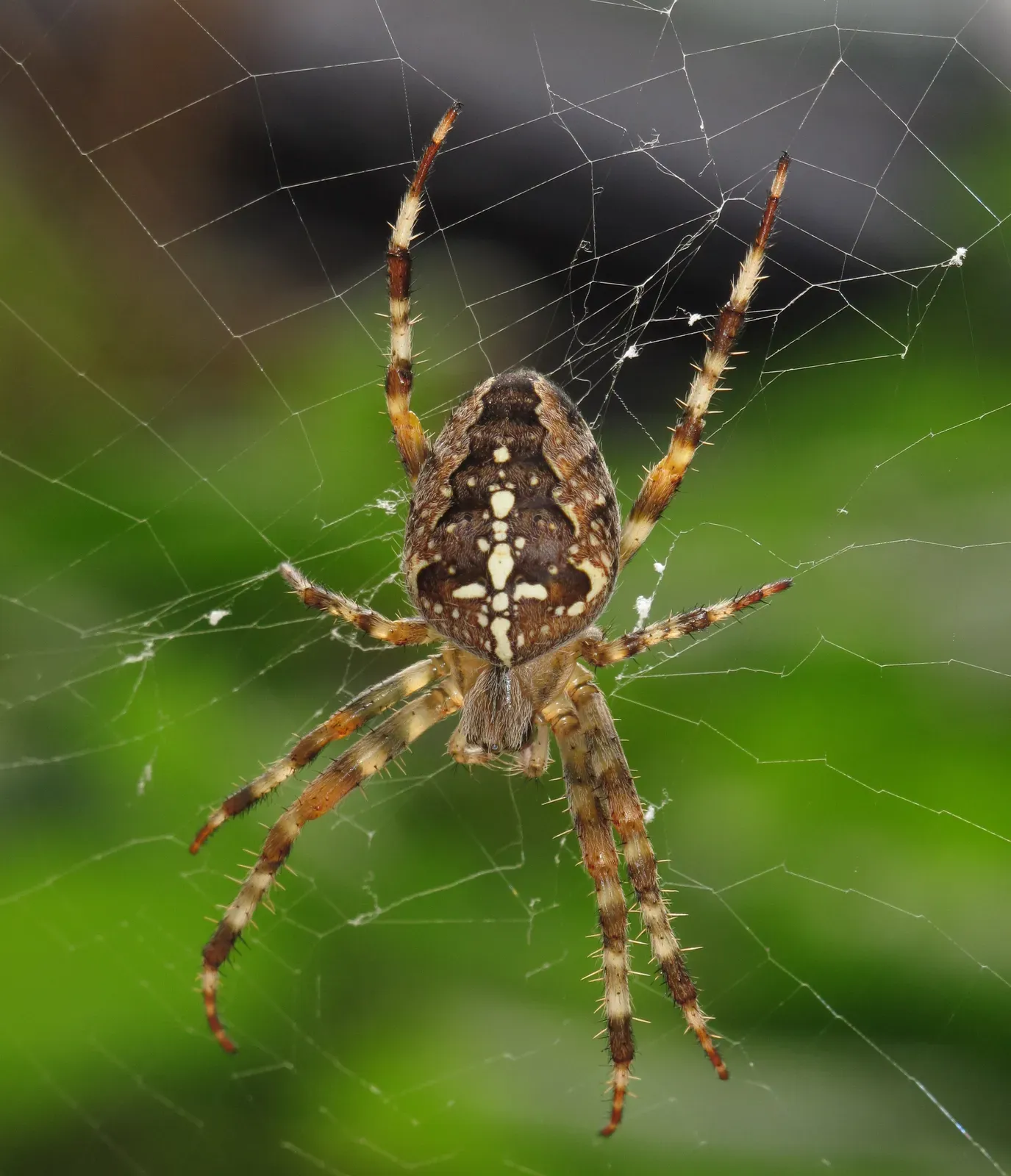
Look closely between leaves, fence posts, or hedgerow stems: the cross orbweaver is building, sensing, repairing, and beginning again.
Who is the spider behind the silken wheel?
The European garden spider is Araneus diadematus, an arachnid also known as the cross orbweaver or diadem spider. Its best-known clue is a pale cross-shaped pattern made from small spots on the top of its rounded abdomen. If you notice that pattern while looking at a web, you may have solved a small garden mystery.
This is not an insect, even though its meals are insects. It belongs to the spider order, Araneae, and to the orb-weaver family, Araneidae. “Orb” is a useful word to remember: it describes the round, wheel-like web that makes this spider such a familiar neighbour.
European garden spiders live in places where plants provide good anchor points for silk: gardens, woodland, hedgerows, and grassland. They occur in Europe and North America. A spider need not be large to make a place feel alive; sometimes a single web between two stems makes you pause and see a patch of green differently.
Evidence: Natural History Museum, London: Garden spiders: the UK’s orb weavers — Natural History Museum; University of Michigan Museum of Zoology: Araneus diadematus — Animal Diversity Web; The Wildlife Trusts: Garden spider — The Wildlife Trusts
How does a web become a hunting tool?
The web is both a sheltering workspace and a clever way to catch flying food. The European garden spider spins a round orb web, arranged like a wheel with lines reaching outward and a spiral running around them. Flies, moths, and small beetles are among the insects caught by this sticky trap.
Rather than racing after prey, the spider waits for information to travel through its carefully placed silk. When an insect meets the web, the whole structure can tremble. That turns a quiet-looking web into a kind of signal system: a message arrives along the threads, and the spider can respond.
It is tempting to call a web a decoration, especially when dew makes every strand shine. But it is also an everyday working tool. A web has to do its job in wind, among moving leaves, and after encounters with insects. The spider’s patient design makes a busy garden feel connected: plant stems hold the web, insects pass by, and a small hunter waits at the centre or nearby.
Evidence: Natural History Museum, London: Garden spiders: the UK’s orb weavers — Natural History Museum; University of Michigan Museum of Zoology: Araneus diadematus — Animal Diversity Web; The Wildlife Trusts: Garden spider — The Wildlife Trusts
Why does this spider eat its old web?
A European garden spider does not simply abandon a worn-out web. When the silk is no longer in good condition, it can roll up the old web, eat the silk, and spin a fresh one. It is a remarkable habit: yesterday’s damaged net becomes part of the material for tomorrow’s new design.
This rebuilding gives the spider’s life a gentle rhythm of making, mending, and beginning again. To us, a torn web may look like the end of a project. To an orb-weaver, it can be the next stage of the work. If you find a web that has changed overnight, the gardener of silk may have been busy while you slept.
Watching without touching is the kindest way to enjoy this process. A web is delicate, and its owner has spent effort creating it. Try looking from different angles instead. In low morning light, the threads may suddenly appear; a step to the side can make them vanish again. That disappearing act is part of the wonder.
Evidence: Natural History Museum, London: Garden spiders: the UK’s orb weavers — Natural History Museum; The Wildlife Trusts: Garden spider — The Wildlife Trusts; University of Michigan Museum of Zoology: Araneus diadematus — Animal Diversity Web
How big is a garden spider’s world?
Its body is small: females are roughly 6.5–20 millimetres long, while males are roughly 5.5–13 millimetres long. Those measurements do not include the legs. A spider that seems enormous when viewed close-up is, in the wider garden, a tiny resident working among leaves, grasses, and stems.
European garden spiders can be active by day and at twilight. Their lives are often about a year long. Adults generally die in late autumn after eggs are laid, while the next generation overwinters as eggs and hatches in spring. This seasonal handover is one reason a familiar web-builder can seem to disappear and return with the changing year.
The species is listed as Not Evaluated by the IUCN in the supplied species information. That does not make every individual web unimportant. Each small animal has its own immediate needs: a secure place to build, time to hunt, and a world that is not constantly disturbed. Respect can start with noticing who shares our outdoor spaces.
Evidence: University of Michigan Museum of Zoology: Araneus diadematus — Animal Diversity Web; The Wildlife Trusts: Garden spider — The Wildlife Trusts; Natural History Museum, London: Garden spiders: the UK’s orb weavers — Natural History Museum
What can we do when we find one?
Begin with curiosity. Notice the pale cross, the spokes of the orb web, and the places where the silk is tied. You might keep a nature notebook and sketch the web’s shape, record the weather, or return later to see whether it has been rebuilt. A drawing is a better souvenir than a spider or a piece of web.
Give the spider room. Avoid poking the web, pulling at its support threads, or trying to move its owner. If a web is in an awkward place, pause before acting: perhaps there is another route around it. Small choices can make a garden or shared outdoor area feel safer for its many residents.
There is also a bigger lesson in a spider’s web. Wildlife does not always announce itself with feathers, fur, or a loud call. It may be waiting quietly between two plants. When we make time to look closely, gardens become more than scenery. They become neighbourhoods, full of lives that are different from ours and still worth considering.
Evidence: Natural History Museum, London: Garden spiders: the UK’s orb weavers — Natural History Museum; The Wildlife Trusts: Garden spider — The Wildlife Trusts; University of Michigan Museum of Zoology: Araneus diadematus — Animal Diversity Web
A tiny web can lead to a bigger kind of kindness
The European garden spider catches insects because that is how this animal lives. We humans have far more choice about our meals, and that choice can be an opportunity for kindness. A meal built around vegetables, fruit, whole grains, pulses, nuts, and seeds can be colourful, satisfying, and full of things to explore in the kitchen.
The World Health Organization describes healthy diets in broad terms that include these plant foods. The IPCC also reports that shifts toward sustainable, healthy, more plant-based diets can reduce food-system emissions and pressure on land and biodiversity. Those are big ideas, but they can begin with something ordinary: trying a bean dish, sharing a fruit snack, or helping cook a plant-based family favourite.
There is no need to be perfect, and children should talk with a trusted adult and a qualified health professional about their own dietary needs. The important thought is simple: when we notice a small spider working hard to live, it can remind us that other animals are not background characters. Choosing more plant-based foods is one gentle way to make room in our imaginations—and in the world—for fellow creatures.
Evidence: World Health Organization: Healthy diet; Intergovernmental Panel on Climate Change: Climate Change 2022: Mitigation of Climate Change — Chapter 7; Natural History Museum, London: Garden spiders: the UK’s orb weavers — Natural History Museum
Kind choices, from the garden to the table
A spider web asks us to slow down: something small has made a home and is getting on with its day. That same attentive feeling can travel with us beyond the garden. Animals are individuals with their own ways of living, and our choices can reflect care for them.
For people who want to explore kinder food choices, plant-forward meals can be a positive place to start. WHO guidance includes vegetables, fruit, whole grains, pulses, nuts, and seeds as parts of healthy diets, while the IPCC finds that more plant-based, sustainable dietary shifts can reduce pressure on climate, land, and biodiversity. Try new foods with joy rather than rules, and ask a trusted adult and qualified health professional for personal guidance when needed.
Evidence: World Health Organization: Healthy diet; Intergovernmental Panel on Climate Change: Climate Change 2022: Mitigation of Climate Change — Chapter 7; Natural History Museum, London: Garden spiders: the UK’s orb weavers — Natural History Museum
Questions people ask
Is the European garden spider an insect?
No. It is a spider: an arachnid in the order Araneae. It eats insects, but it is not one itself.
Evidence: University of Michigan Museum of Zoology: Araneus diadematus — Animal Diversity Web; Natural History Museum, London: Garden spiders: the UK’s orb weavers — Natural History Museum
What does the pale cross mean?
The pale spots form a cross-shaped pattern on the abdomen. This marking inspired names such as cross orbweaver.
Evidence: Natural History Museum, London: Garden spiders: the UK’s orb weavers — Natural History Museum; The Wildlife Trusts: Garden spider — The Wildlife Trusts
What does it eat?
Its food includes flying insects such as flies, moths, and small beetles, caught in its orb web.
Evidence: Natural History Museum, London: Garden spiders: the UK’s orb weavers — Natural History Museum; University of Michigan Museum of Zoology: Araneus diadematus — Animal Diversity Web
Why might a web disappear from one day to the next?
The spider may have taken down a worn web, eaten the old silk, and begun building a new one.
Evidence: Natural History Museum, London: Garden spiders: the UK’s orb weavers — Natural History Museum; The Wildlife Trusts: Garden spider — The Wildlife Trusts
Where might I spot one?
Look carefully in gardens, woodland, hedgerows, and grassland, especially where plants offer places to anchor a web.
Evidence: University of Michigan Museum of Zoology: Araneus diadematus — Animal Diversity Web; The Wildlife Trusts: Garden spider — The Wildlife Trusts
Read the evidence
Sources behind this story
- Garden spiders: the UK's orb weavers — Natural History Museum — Natural History Museum, London
- Araneus diadematus — Animal Diversity Web — University of Michigan Museum of Zoology
- Garden spider — The Wildlife Trusts — The Wildlife Trusts
- Healthy diet — World Health Organization
- Climate Change 2022: Mitigation of Climate Change — Chapter 7 — Intergovernmental Panel on Climate Change
Health information is general education, not personal medical advice. Young readers should make food choices with a trusted adult and qualified health professional.