Today's animal friend · 21 July 2026
Goats: The Bright-Eyed Climbers of the Farmyard
Domestic goats are familiar companions in many places, yet there is nothing ordinary about their agile hooves, sociable herds, and lively appetite for leaves.
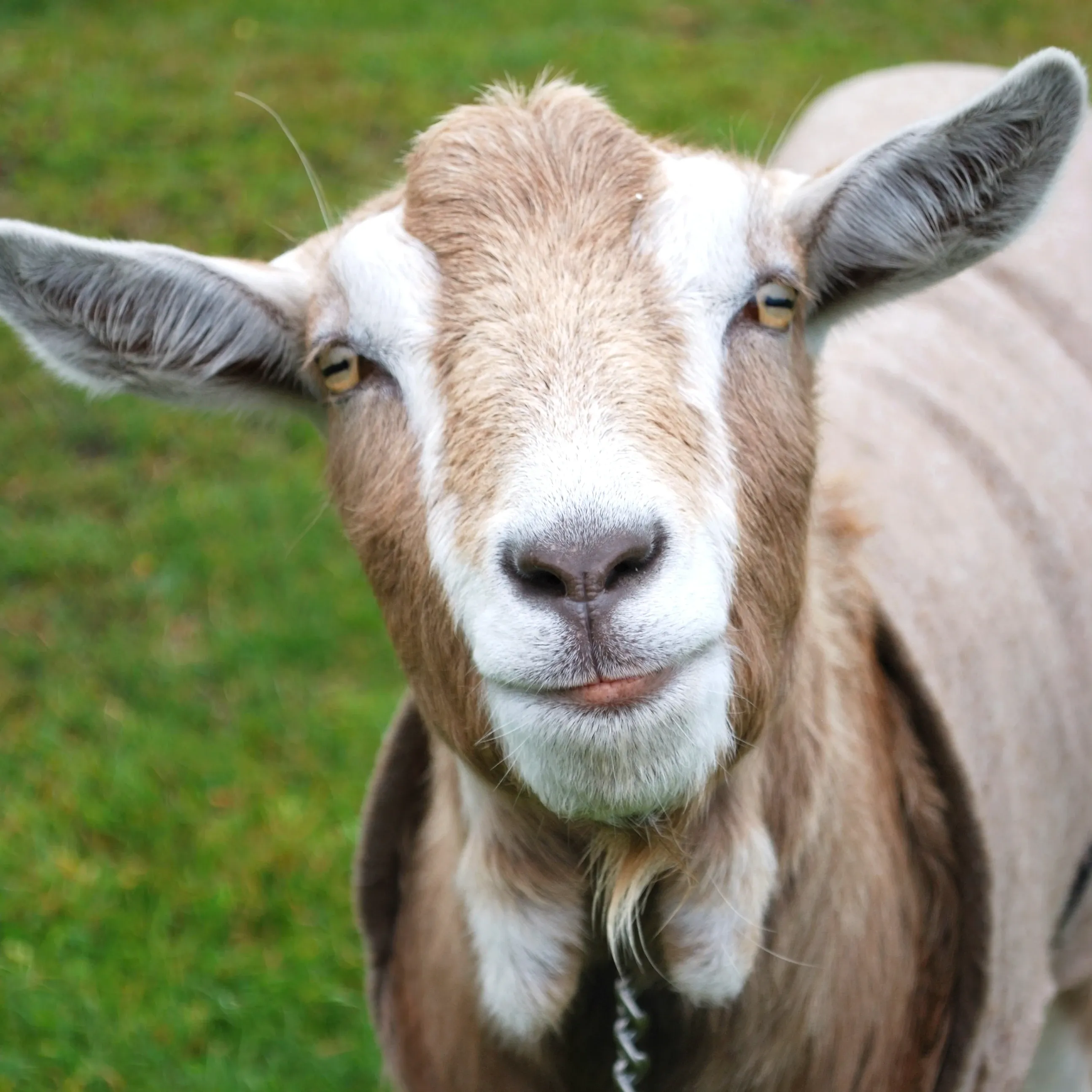
Domestic goats are familiar companions in many places, yet there is nothing ordinary about their agile hooves, sociable herds, and lively appetite for leaves.
A goat is a small explorer with hooves
A goat can make an ordinary field feel like an adventure course. One moment it may be browsing quietly among grass and shrubs; the next, it may be stepping neatly onto a rock, a low wall, or another tempting perch. Domestic goats are Capra hircus, mammals in the bovid family, alongside other hoofed, cud-chewing animals. They have lived alongside people for a very long time and were domesticated from the wild goat, Capra aegagrus, in Southwest Asia and Eastern Europe roughly 10,000 years ago.
Today, people keep goats across much of the world. They can live where livestock are cared for in farmland, grassland, hills, and mountains, and feral goats may use rugged crags and alpine meadows. Their wide spread does not mean every place is suitable: goats need thoughtful care and do best with the food, shelter, companionship, and secure boundaries that their lives require.
Goats vary enormously among breeds, so there is no single perfect goat shape or size. A typical adult described by Animal Diversity Web is around 64 centimetres tall and 45 kilograms, while breeds can be much smaller or larger. That variety is part of the charm of meeting goats: each one may look a little different, but the alert eyes and investigating nose are often unmistakable.
Evidence: IUCN Red List of Threatened Species: Capra hircus (domestic goat) — conservation status; Animal Diversity Web, University of Michigan Museum of Zoology: Capra hircus (domestic goat); Wikipedia: Goat (Capra hircus)
Their favourite menu is a browse, not just a lawn
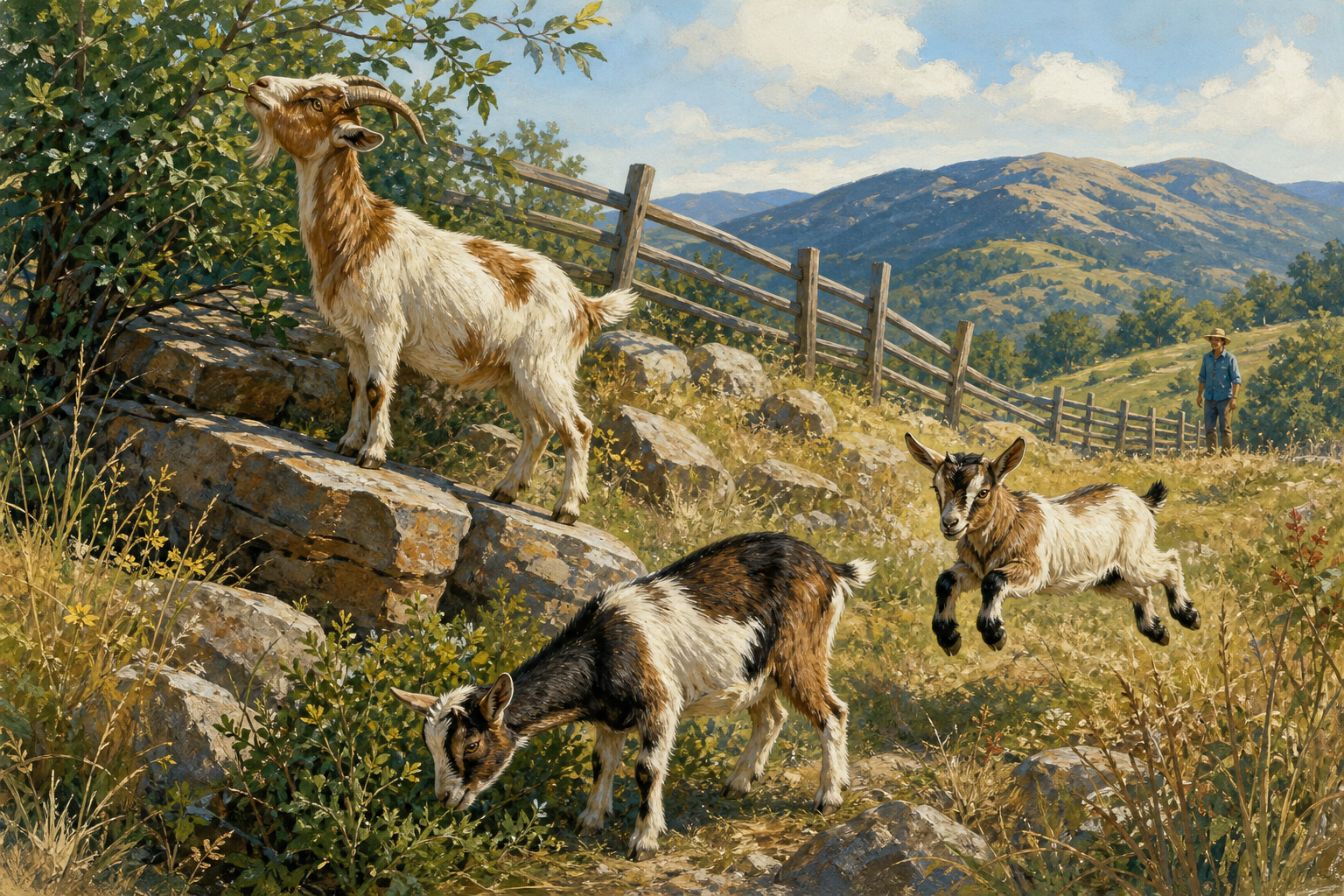
Goats are herbivorous ruminants. Their food includes grasses and shrubs, and they are especially known as browsers: animals that reach for leaves, twigs, and other plant growth rather than simply cropping a smooth lawn. Hay and other roughage are important when goats are in human care. A goat’s interest in a leafy branch is not fussiness—it is part of its natural way of selecting food.
They also choose carefully. Animal Diversity Web notes that goats generally avoid grass soiled by droppings. This makes sense when we remember that eating is a large part of a goat’s daytime work. Goats are diurnal, meaning they are active during the day, and much of that time can be spent grazing or browsing.
Their climbing talent makes the menu even more interesting. Goats are agile climbers and are described as the only ruminant that regularly climbs trees. A branch held high is not necessarily out of reach to a determined goat. For a young reader watching one stretch upward, it can seem as though the goat has turned a snack into a puzzle—and then solved it with balance, patience, and a quick nibble.
Evidence: Animal Diversity Web, University of Michigan Museum of Zoology: Capra hircus (domestic goat); Wikipedia: Goat (Capra hircus)
Kids are ready to bounce into the world
A baby goat is called a kid. Adult females may be called does or nannies, while adult males may be called bucks or billies. These friendly words fit animals that often create a busy, social scene. Goats prefer the company of other goats, and wild or feral herds are often made up of several animals together rather than one lone wanderer.
Kids are precocial, which means they can walk and follow their mother within hours of birth. Their early wobbles soon become hops, skips, and springy leaps. Play can look wonderfully silly to us, but it helps turn uncertain legs into skilled ones. A rock, a stump, or a harmless raised spot becomes a tiny mountain to conquer.
Goat groups have their own social rules. Males may compete for rank by head-butting, and goats can remember familiar companions. They are also widely described as curious. Their curiosity is not a trick for an audience; it is a useful way of meeting a changing world—testing a new object, investigating an opening, or working out what lies beyond a fence. That lively mind is one reason a goat deserves patient, kind care rather than being treated as a decoration in a field.
Evidence: Animal Diversity Web, University of Michigan Museum of Zoology: Capra hircus (domestic goat); Wikipedia: Goat (Capra hircus)
Cleverness comes with a talent for getting into places
Goats have a reputation for investigating everything, and the evidence behind the joke is real: they readily test fences. Their agility, reach, and interest in new things can make an enclosure seem less like a final answer and more like a question waiting to be explored. Secure fencing matters not because goats are “naughty,” but because it helps keep them safe and prevents them from wandering into roads, gardens, or fragile habitats.
Some research summaries also report that goats may look to people for help when faced with a new challenge, in a way compared with dogs and horses. It is a lovely reminder that attention is a two-way bridge. When we pause to notice an animal’s body language, space, and needs, we make room for trust instead of expecting the animal to fit our plans.
A good goat home is more than a patch of ground. Welfare-minded care includes shelter, adequate forage, veterinary care, companions, and boundaries that are safe and reliable. Since goats are social herd animals, company matters. Since they are browsers and climbers, their surroundings should be managed with their lively habits in mind. Being an animal friend sometimes means admiring an animal’s adventurous spirit while making sure that adventure does not lead to danger.
Evidence: Animal Diversity Web, University of Michigan Museum of Zoology: Capra hircus (domestic goat); Wikipedia: Goat (Capra hircus)
A worldwide domestic animal still needs careful land care
Domestic goats are abundant worldwide and are not evaluated by the IUCN Red List as a wild species would be. This is important wording: Capra hircus is a domesticated form, while its wild ancestor, Capra aegagrus, is a separate species assessed on its own. “Not evaluated” is not the same as a warning label about every individual goat; it simply reflects how the Red List treats domesticated animals.
Still, being common does not make a goat’s life unimportant, and it does not mean goats can be placed anywhere without consequences. Where goats become feral or graze without careful management, their browsing can contribute to erosion, slow the return of vegetation, and harm native plants, especially on islands. In other managed settings, goats may be used to help control invasive weeds. The difference is thoughtful stewardship: people paying close attention to animal welfare, soil, plants, and the wider habitat.
That makes goats an excellent lesson in connection. A goat is an individual with its own appetite, companions, and daily routines. It is also part of a landscape. Caring well means considering both: does this goat have what they need, and is the land being protected for the many lives that depend on it?
Evidence: IUCN Red List of Threatened Species: Capra hircus (domestic goat) — conservation status; Animal Diversity Web, University of Michigan Museum of Zoology: Capra hircus (domestic goat); Wikipedia: Goat (Capra hircus)
Try the Goat-Spotter Challenge
If you visit goats with a responsible adult, become a quiet observer rather than a chaser. Can you see one browsing leaves or twigs? Does a goat pause to look at another member of the group? Is there a safe high place that seems especially popular? Notice how much information a goat gathers with its eyes, ears, nose, and careful steps.
Keep a respectful distance, follow the rules of the place, and never offer food unless the caregiver says it is appropriate. A goat’s digestive system and diet need careful management, and even a friendly animal deserves the choice not to be crowded. You might sketch the shape of its horns if present, its coat pattern, or the path it chooses across the ground.
Then take the goat’s lesson home: curiosity can be gentle. Ask what plants grow nearby, how food reaches your plate, and what choices help animals and habitats flourish. You do not have to climb a tree to see the world with fresh interest—although a goat might recommend trying a different route to the same leafy branch.
Evidence: Animal Diversity Web, University of Michigan Museum of Zoology: Capra hircus (domestic goat); Wikipedia: Goat (Capra hircus)
A kind choice can begin with seeing the goat as someone
When a goat reaches for a leaf, stays close to a companion, or works out how to cross a tricky spot, it is easy to see a personality at work. That recognition can guide everyday kindness. We can choose visits and sanctuaries that put animals’ needs first, support careful land management, and make room in our meals for more plant foods.
The World Health Organization describes healthy diets in broad terms that include whole grains, vegetables, fruit, pulses, nuts, and seeds. With a trusted adult and, where useful, a qualified health professional, families can explore delicious plant-forward or vegan meals that suit them. Think bean tacos, lentil soup, vegetable noodles, fruit, and nut or seed toppings—not as a test of perfection, but as a cheerful way to widen the menu.
There is a planet-sized reason to enjoy those choices, too. The IPCC reports that shifts toward sustainable, healthy, more plant-based diets can reduce food-system emissions and pressure on land and biodiversity. A meal cannot solve everything alone. But choosing more plants can be one gentle, practical way to care about goats, other animals, and the living places they share with us.
Evidence: World Health Organization: Healthy diet; Intergovernmental Panel on Climate Change: Climate Change 2022: Mitigation of Climate Change — Chapter 7; Animal Diversity Web, University of Michigan Museum of Zoology: Capra hircus (domestic goat); Wikipedia: Goat (Capra hircus)
Questions people ask
Why do goats climb?
Goats are agile climbers, and their browsing lifestyle can lead them toward leaves, twigs, and shrubs that are above the ground. Their sure-footed exploring also helps explain why they test fences and enjoy raised places.
Evidence: Animal Diversity Web, University of Michigan Museum of Zoology: Capra hircus (domestic goat); Wikipedia: Goat (Capra hircus)
Are goats vegetarians?
Goats are herbivores and ruminants. They eat plant foods such as grasses and shrubs, selecting forage carefully; goats in care also need suitable roughage throughout the year.
Evidence: Animal Diversity Web, University of Michigan Museum of Zoology: Capra hircus (domestic goat); Wikipedia: Goat (Capra hircus)
What is a baby goat called?
A baby goat is a kid. Kids can walk and follow their mother within hours of birth, then quickly become famous for their bouncy play.
Evidence: Animal Diversity Web, University of Michigan Museum of Zoology: Capra hircus (domestic goat); Wikipedia: Goat (Capra hircus)
Are domestic goats endangered?
Domestic goats are not evaluated by the IUCN Red List because they are domesticated animals. The wild goat, Capra aegagrus, is a separate species with its own assessment.
Evidence: IUCN Red List of Threatened Species: Capra hircus (domestic goat) — conservation status; Animal Diversity Web, University of Michigan Museum of Zoology: Capra hircus (domestic goat); Wikipedia: Goat (Capra hircus)
Read the evidence
Sources behind this story
- Capra hircus (domestic goat) — conservation status — IUCN Red List of Threatened Species
- Capra hircus (domestic goat) — Animal Diversity Web, University of Michigan Museum of Zoology
- Goat (Capra hircus) — Wikipedia
- Healthy diet — World Health Organization
- Climate Change 2022: Mitigation of Climate Change — Chapter 7 — Intergovernmental Panel on Climate Change
Health information is general education, not personal medical advice. Young readers should make food choices with a trusted adult and qualified health professional.