Today's animal friend · 15 July 2026
Atlantic Salmon: The Fish That Finds Its Way Home
Atlantic salmon, Salmo salar, link rivers and ocean on a life-changing migration. Their journey is brave, beautiful, and increasingly difficult, which makes every restored stream and caring choice matter.
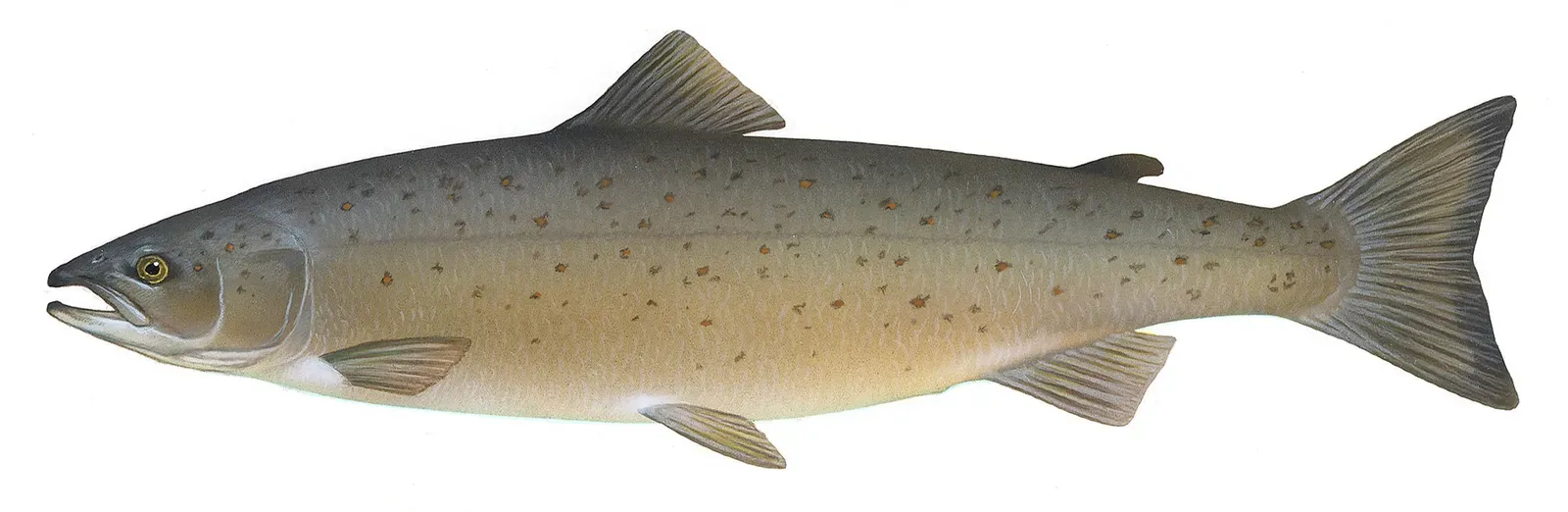
Atlantic salmon, Salmo salar, link rivers and ocean on a life-changing migration. Their journey is brave, beautiful, and increasingly difficult, which makes every restored stream and caring choice matter.
Meet the river-and-ocean traveller
An Atlantic salmon is a silvery member of the salmon family whose life connects two very different worlds: freshwater rivers and the North Atlantic Ocean. Its scientific name is Salmo salar. Young salmon begin life in a river, while adults spend important growing years at sea. Then, when it is time to reproduce, they make the remarkable trip back toward the river where they began.
Picture a fish built for a grand commute. After about two winters in the ocean, an Atlantic salmon may be roughly 71 to 76 centimetres long—about the length of a baseball bat—and some grow toward a metre. Size varies with the time a fish spends feeding at sea. Atlantic salmon commonly live around four to six years, though each individual’s path is its own.
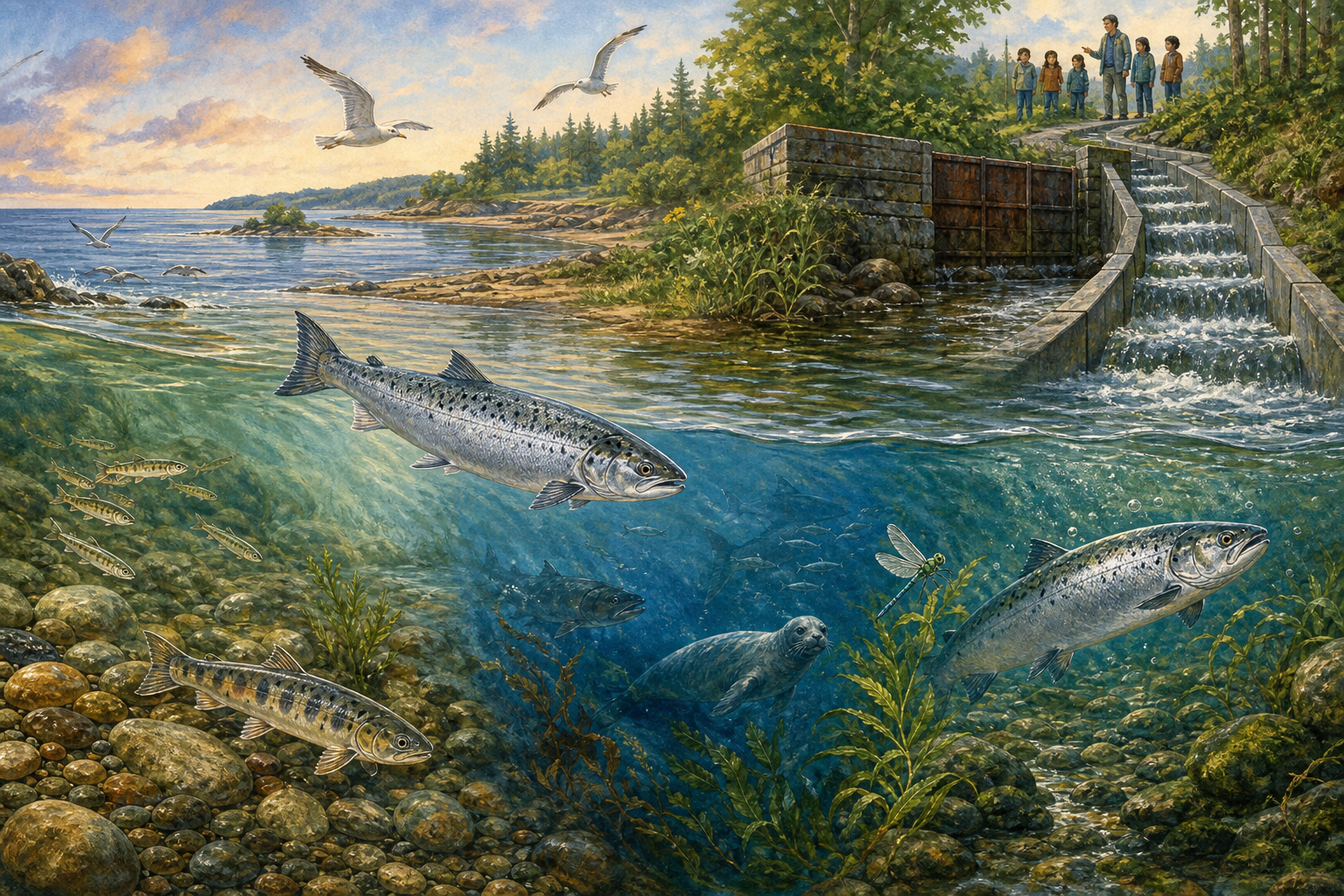
They are hunters, not plant-eaters. In rivers, young salmon take insects and other small water-dwelling invertebrates. In the ocean, adults eat crustaceans and smaller fish. In turn, salmon are part of a much larger web of river and sea life, serving as prey for other animals too. A salmon is never simply “a fish”: it is a moving neighbour in a busy living world.
Evidence: IUCN Red List of Threatened Species: Salmo salar (Atlantic Salmon) — Red List category; NOAA Fisheries (U.S. National Oceanic and Atmospheric Administration): Atlantic Salmon (Protected) — Species Profile; North Atlantic Salmon Conservation Organization (NASCO): State of North Atlantic Salmon
Why do Atlantic salmon travel so far?
The short answer is: growing up and raising the next generation happen in different places. Atlantic salmon hatch and spend their early life in cool, well-oxygenated rivers, where gravel or cobble on the riverbed provides the setting for their beginnings. Later, many head through coastal waters and into the ocean, where they feed and grow.
This river-to-sea-and-back life is called anadromy. It is an extraordinary pattern because the salmon must cope with changing water conditions, long distances, and the obstacles of an altered world. Yet the destination is often wonderfully specific: Atlantic salmon usually return to their natal river—the river where they were born—to spawn, or lay eggs.
Not every detail of the journey is the same for every salmon, and nature does not issue travel tickets. Still, the overall story is clear: a young fish in a river can become a powerful ocean traveller and later turn homeward. That homeward movement is one reason healthy, connected rivers matter so much. A river is not just scenery beside a town or trail; for salmon, it can be a nursery, a route, and a homecoming place.
Evidence: NOAA Fisheries (U.S. National Oceanic and Atmospheric Administration): Atlantic Salmon (Protected) — Species Profile; North Atlantic Salmon Conservation Organization (NASCO): State of North Atlantic Salmon; Wikipedia: Atlantic salmon
A return journey with a surprising second chance
Many people have heard that salmon swim upstream to reproduce. Atlantic salmon add an important twist to that familiar tale. Unlike Pacific salmon, an Atlantic salmon does not always die after spawning. Some survive, return to the sea, and may make the journey again in another year. It is possible, not guaranteed—and that makes each return all the more impressive.
Imagine the effort involved. A salmon leaving the sea must exchange open ocean space for the narrower, flowing world of a river. It may encounter fast water, changing temperatures, and barriers placed in its path. Its journey is not a stunt for us to cheer from the riverbank. It is part of the animal’s life, shaped by an ancient relationship between river and ocean.
Young salmon have challenges close to home as well. Juvenile parr are largely territorial when defending feeding space, rather than being permanent schoolmates. This is a useful reminder that “salmon” is not one single behaviour. Their needs and habits change as they grow, move, and meet different habitats.
Evidence: NOAA Fisheries (U.S. National Oceanic and Atmospheric Administration): Atlantic Salmon (Protected) — Species Profile; North Atlantic Salmon Conservation Organization (NASCO): State of North Atlantic Salmon; Wikipedia: Atlantic salmon
What makes the homeward route harder?
Globally, Atlantic salmon are listed as Near Threatened on the IUCN Red List, with a decreasing population trend. That is serious news, but it is not a reason to give up. It is a reason to notice the pressures salmon face and support thoughtful work that gives rivers and fish a better chance.
Dams and other barriers can block access to river habitat. Pollution and habitat degradation can make freshwater places less suitable. Overfishing, low survival in the ocean, climate change, and pressures connected with aquaculture—including escapes and sea lice—can also make salmon life harder. The mix of problems differs among rivers and ocean regions, so good care has to pay attention to local conditions rather than rely on one quick fix.
There is an important detail to keep straight: the global IUCN assessment is Near Threatened. In the United States, the Gulf of Maine distinct population segment has a separate Endangered listing under the Endangered Species Act. One salmon name can appear in different conservation systems, and careful language helps us understand what each label actually means.
Hope has practical shapes. Barrier removal and fish passage can reconnect routes. River-habitat and water-quality restoration can improve freshwater homes. International harvest controls, coordinated through the North Atlantic Salmon Conservation Organization, are also part of the bigger effort. In places where wild stocks are critically depleted, conservation hatcheries may be used as one tool. None of these actions is magic, but together they show that people can choose to repair connections.
Evidence: IUCN Red List of Threatened Species: Salmo salar (Atlantic Salmon) — Red List category; NOAA Fisheries (U.S. National Oceanic and Atmospheric Administration): Atlantic Salmon (Protected) — Species Profile; North Atlantic Salmon Conservation Organization (NASCO): State of North Atlantic Salmon
Be a good neighbour to a travelling fish
You do not have to live beside a salmon river to care about Atlantic salmon. Start by seeing water as shared habitat. Keep litter out of drains and streams, learn where local water flows, and join a trusted cleanup or habitat project if one is available. Ask adults at school, libraries, nature centres, or community groups about river restoration and fish passage in your region.
Curiosity is another kind of care. If you visit a river, watch quietly. Notice the current, stones, insects, birds, and plants. These are clues that a river is a community, not merely a channel of water. If people are fishing, boating, or working nearby, respectful distance and local rules help wild animals have the space they need.
Most of all, let the salmon’s journey stretch your imagination. An animal may begin as a tiny river fish, travel through coastal waters to the broad ocean, and still depend on a particular freshwater route years later. Protecting nature often means protecting the connections we cannot immediately see.
Evidence: NOAA Fisheries (U.S. National Oceanic and Atmospheric Administration): Atlantic Salmon (Protected) — Species Profile; North Atlantic Salmon Conservation Organization (NASCO): State of North Atlantic Salmon; IUCN Red List of Threatened Species: Salmo salar (Atlantic Salmon) — Red List category
A kind choice at the table can be part of the story
Atlantic salmon are wild individuals with homes, journeys, and needs of their own—not ingredients waiting at the end of a supply chain. Caring about them can include caring for rivers, supporting conservation, and making everyday choices that leave more room for animals to live their own lives.
One gentle way to practise that care is to explore plant-based meals: perhaps bean tacos, lentil pasta sauce, chickpea sandwiches, vegetable stir-fries, or a favourite family recipe with a plant-based swap. The World Health Organization describes healthy diets in broad terms that include vegetables, fruits, whole grains, pulses, nuts, and seeds. Food needs are personal, so children should talk with a trusted adult and a qualified health professional for individual guidance.
Choosing more plant-forward foods can also be a hopeful climate action. The IPCC reports that shifts toward sustainable, healthy, more plant-based diets can reduce food-system emissions and pressure on land and biodiversity. It is not about being perfect or judging anyone’s family. It is about trying delicious, compassionate choices—and remembering that a living salmon deserves a river route home.
Evidence: World Health Organization: Healthy diet; Intergovernmental Panel on Climate Change: Climate Change 2022: Mitigation of Climate Change — Chapter 7; IUCN Red List of Threatened Species: Salmo salar (Atlantic Salmon) — Red List category; NOAA Fisheries (U.S. National Oceanic and Atmospheric Administration): Atlantic Salmon (Protected) — Species Profile
Questions people ask
Are Atlantic salmon the same as Pacific salmon?
No. Atlantic salmon are Salmo salar, while Pacific salmon belong to a different genus, Oncorhynchus. One notable difference is that some Atlantic salmon can survive spawning and reproduce again.
Evidence: NOAA Fisheries (U.S. National Oceanic and Atmospheric Administration): Atlantic Salmon (Protected) — Species Profile; Wikipedia: Atlantic salmon; North Atlantic Salmon Conservation Organization (NASCO): State of North Atlantic Salmon
Where do Atlantic salmon live?
Their life links cool freshwater rivers, coastal waters, and the North Atlantic Ocean. They are native to North Atlantic rivers and seas in Europe and North America.
Evidence: NOAA Fisheries (U.S. National Oceanic and Atmospheric Administration): Atlantic Salmon (Protected) — Species Profile; North Atlantic Salmon Conservation Organization (NASCO): State of North Atlantic Salmon; Wikipedia: Atlantic salmon
What do Atlantic salmon eat?
Young salmon eat insects and other aquatic invertebrates. At sea, adults eat crustaceans and smaller fish.
Are Atlantic salmon endangered?
Globally, Atlantic salmon are listed as Near Threatened by the IUCN. Separately, the U.S. Gulf of Maine population is listed as Endangered under U.S. law.
Evidence: IUCN Red List of Threatened Species: Salmo salar (Atlantic Salmon) — Red List category; NOAA Fisheries (U.S. National Oceanic and Atmospheric Administration): Atlantic Salmon (Protected) — Species Profile
What can help salmon return to rivers?
Removing barriers, creating fish passage, restoring river habitat and water quality, and carefully managing harvest can help reconnect and protect salmon life cycles.
Evidence: NOAA Fisheries (U.S. National Oceanic and Atmospheric Administration): Atlantic Salmon (Protected) — Species Profile; North Atlantic Salmon Conservation Organization (NASCO): State of North Atlantic Salmon
Read the evidence
Sources behind this story
- Salmo salar (Atlantic Salmon) — Red List category — IUCN Red List of Threatened Species
- Atlantic Salmon (Protected) — Species Profile — NOAA Fisheries (U.S. National Oceanic and Atmospheric Administration)
- Atlantic salmon — Wikipedia
- State of North Atlantic Salmon — North Atlantic Salmon Conservation Organization (NASCO)
- Healthy diet — World Health Organization
- Climate Change 2022: Mitigation of Climate Change — Chapter 7 — Intergovernmental Panel on Climate Change
Health information is general education, not personal medical advice. Young readers should make food choices with a trusted adult and qualified health professional.