 Real photograph
 Ring-tailed lemur
Lemur catta
say it RING-tayld LEE-mur
Why we love them
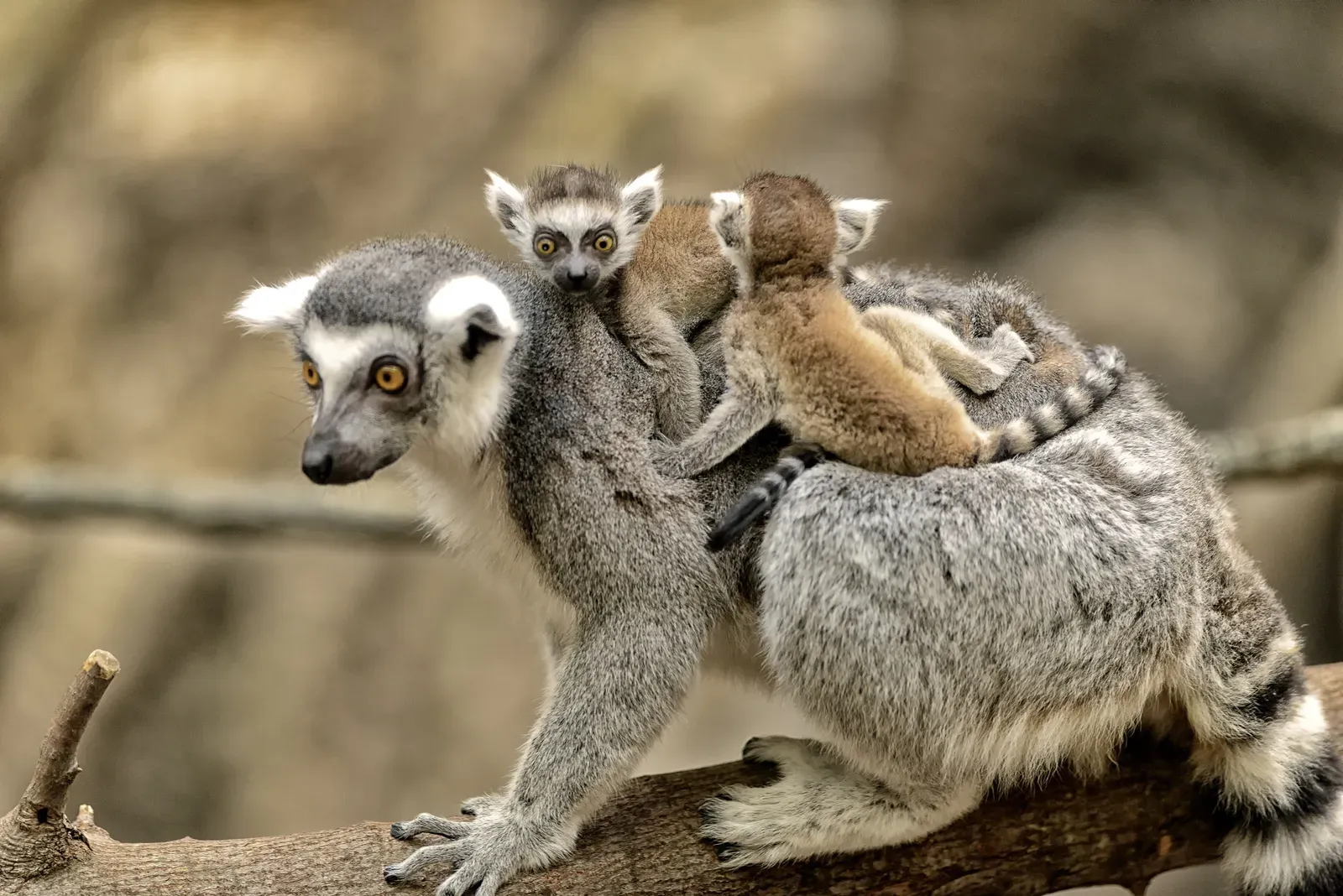
The ring-tailed lemur is a small, furry animal with a soft grey coat, a pointed face, and bright golden eyes. Its most famous feature is its long tail, ringed with about a dozen black and white bands like a stripy scarf. Ring-tailed lemurs live in just one place in the whole world: the island of Madagascar, off the coast of Africa.
Lemurs live together in family groups called troops, and a troop can have around fifteen to twenty members. In a lemur troop the mothers, aunts, and sisters are in charge. The females decide where the troop will go and who eats first, and even the smallest, youngest mother outranks every male in the group.
A lemur family is full of babies to look after. A newborn is tiny, about the weight of a small apple, and it holds tightly to its mother’s tummy wherever she goes. After a week or two it climbs onto her back and rides along like a little jockey, peeking out at the world as she leaps from branch to branch.
Ring-tailed lemurs spend more time on the ground than most of their lemur cousins. They wander through the forest looking for food, and they love to eat fruit, especially the sweet-and-sour pods of the tamarind tree, along with leaves and flowers. They are also some of the noisiest primates, chatting to one another with purrs, clicks, and yaps to keep the troop together.
On a cool morning you might spot a lemur doing something that looks a lot like yoga. It sits up straight, rests its paws on its knees, and opens its arms to turn its pale belly toward the sun. This is how lemurs warm up before a busy day, soaking up the sunshine like little sun-bathers.
There are far fewer ring-tailed lemurs than there used to be, and they are listed as Endangered. Much of their forest home has been cleared, which leaves them less room to roam. Kind people in Madagascar and around the world are protecting the forests and running special reserves so that these sunbathing, stripy-tailed families have a safe place to live.
My home
Forest, gallery forest, dry scrub, spiny forest
Where I live
Africa
What I eat
Fruit, tamarind, leaves, flowers, sap, insects
How long I am
0.39–0.46 m
How heavy I am
2–3.5 kg
How long I live
16–27 years
Ring-tailed lemurs live in family troops that are led by the females, and even the lowest-ranked mother is in charge of every male in the group.
A new baby rides everywhere with its mother, clinging to her tummy at first and then riding on her back like a tiny jockey.
On chilly mornings a lemur will sit up straight and open its arms to the sun, warming its belly like it is doing gentle yoga.
Every ring-tailed lemur can feel happy, scared and loved — just like you.
Looking after my friends
Needs our helpThere are not many left, but people all over the world are helping them recover.
You can help by learning their names, keeping wild places clean, and telling someone why this animal matters.
Where this came from
- Lemur catta (Ring-tailed Lemur) — Red List Assessment — IUCN Red List of Threatened Species
- Lemur catta (ring-tailed lemur) — Animal Diversity Web, University of Michigan Museum of Zoology
- Ring-tailed lemur — Wikipedia