 Real photograph
 Red-bellied piranha
Pygocentrus nattereri
say it PY-goh-SEN-truss na-tuh-RAIR-ee
Why we love them
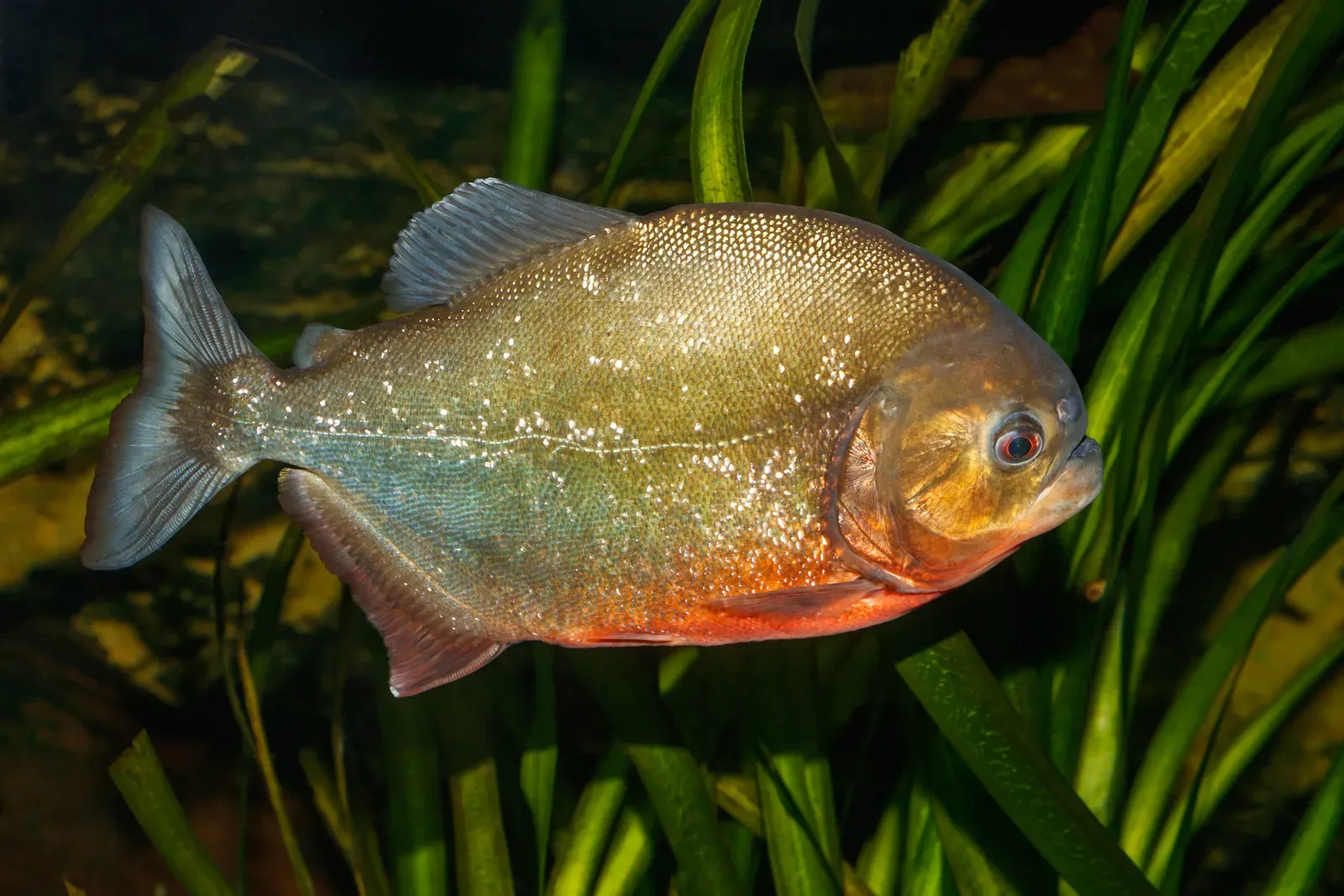
The red-bellied piranha is a silvery freshwater fish with a rosy, red-orange belly. It lives in the warm rivers, streams, and lakes of South America, in places like the mighty Amazon. Young piranhas start out silvery with dark speckles, and the belly turns red as they grow up.
Piranhas have a scary reputation, but the real fish is much calmer and shyer than the stories. Most of the time a red-bellied piranha is a scavenger and forager. It eats fruit and seeds that fall into the water, along with insects, water plants, small fish, and bits of animals that are already dead. During the rainy season, when food is everywhere, it happily munches on plants and bugs.
These fish love company and travel together in groups called shoals. For a long time people thought they swam in groups to hunt, but scientists discovered the opposite is true. The piranhas gather to keep each other safe, because plenty of bigger animals, like river dolphins, caimans, and large birds, would like to eat them.
A red-bellied piranha is usually about the length of a school ruler, and the biggest ones can grow to around half a metre. They have strong jaws and sharp, triangle-shaped teeth that are perfect for snipping food into pieces, a bit like tiny scissors.
Red-bellied piranhas are not rare. They live across a huge stretch of South America and are listed as Least Concern, which means there are still plenty of them swimming in the wild. They are a shy, misunderstood fish that plays an important part in keeping their rivers clean and healthy.
My home
River, freshwater, lake
Where I live
South America
What I eat
Fish, insects, fruit, seeds, water plants, carrion
How long I am
0.35–0.5 m
How heavy I am
3.9 kg
The red-bellied piranha has a fierce reputation, but it is mostly a scavenger and forager that eats fruit, seeds, insects, and animals that are already weak or dead.
They swim in big groups called shoals, and scientists have found the fish gather mainly to stay safe from bigger animals, not to hunt as a team.
Grown-up red-bellied piranhas have a reddish belly, while the young ones are silvery with darker spots.
Every red-bellied piranha can feel happy, scared and loved — just like you.
Looking after my friends
Doing wellThere are lots of these animals in the wild right now. That is good news!
You can help by learning their names, keeping wild places clean, and telling someone why this animal matters.
Where this came from
- Pygocentrus nattereri (Red-bellied Piranha) — Red List status — IUCN Red List of Threatened Species
- Pygocentrus nattereri (Redbelly piranha) — Animal Diversity Web, University of Michigan Museum of Zoology
- Red-bellied piranha — Wikipedia, the free encyclopedia