 Real photograph
 Luna moth
Actias luna
say it LOO-nuh MOTH
Why we love them
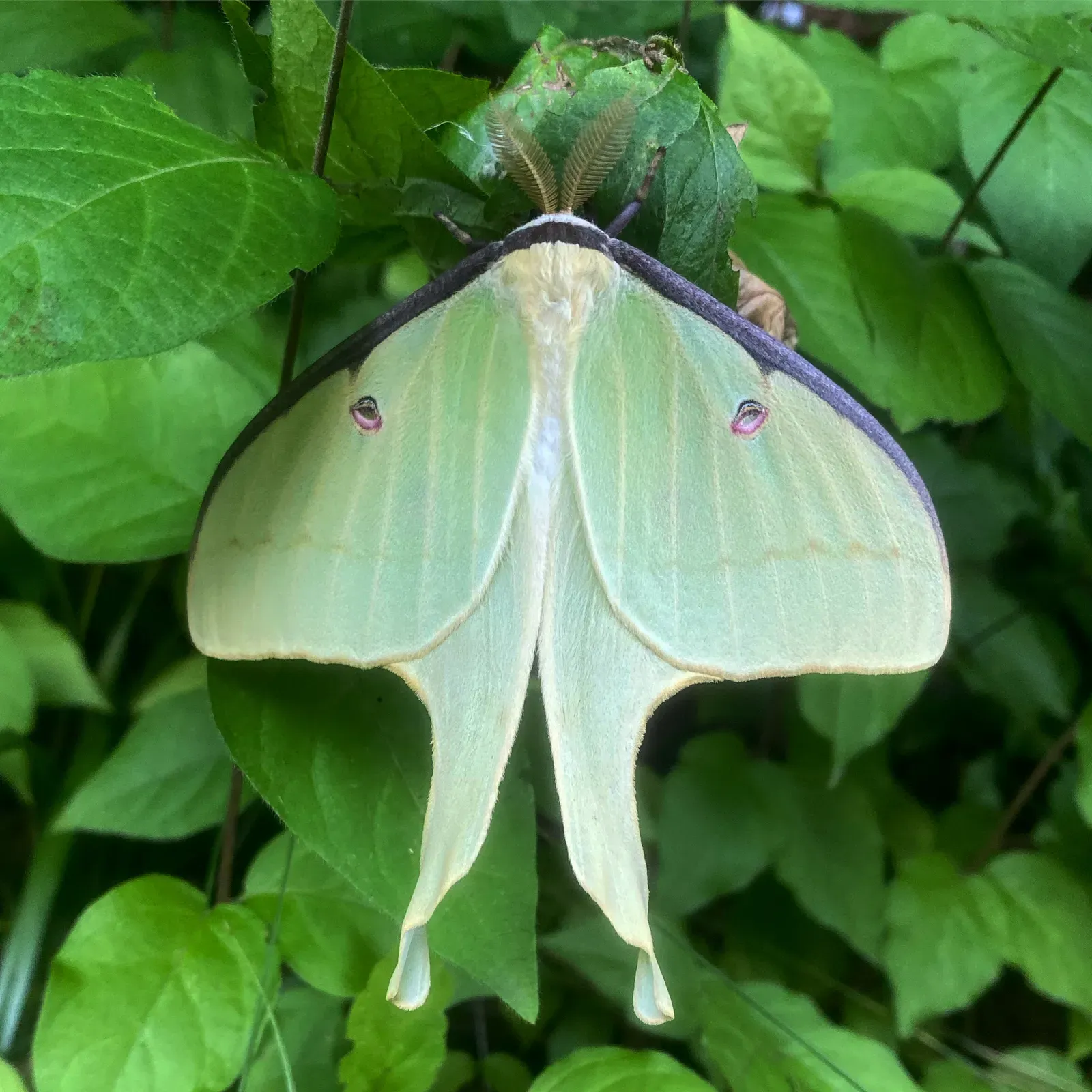
The luna moth is one of the most beautiful insects in North America. Its big, soft wings are a dreamy pale green, edged with a thin line of colour, and each back wing trails a long, curling tail. When it opens its wings, they can stretch as wide as your hand, glowing like a little piece of the moon — which is exactly how it got its name.
Luna moths have a very short and gentle grown-up life. When a moth first climbs out of its silky cocoon, its wings are small, damp, and crumpled. It waits a few hours, quietly pumping them full until they spread wide, dry, and ready to fly. After all that careful work, its flying days last only about a week.
Here is something surprising: a grown-up luna moth never eats a single meal. It does not even have a working mouth. Instead, it lives entirely on energy it saved up as a hungry caterpillar. Because its time is so short, a luna moth spends its whole adult life on one happy task — finding another moth so there can be baby caterpillars next year.
Those caterpillars are bright green and munch the leaves of trees like birch, walnut, hickory, and sweet gum. They eat and eat, growing plump, then spin a cocoon to rest inside while they slowly change into a moth. Luna moths fly only at night, which is why, even though they are not rare, people so rarely get to see one.
No one has given the luna moth an official worldwide conservation grade, so its status is “not evaluated,” though wildlife trackers in North America still count it as a safe and steady species. Leaving leafy trees and quiet, dark corners in our gardens gives these gentle night-fliers plenty of room to flutter.
My home
Woodland, forest
Where I live
North America
What I eat
Birch leaves, walnut leaves, hickory leaves, sweet gum leaves
How long I am
0.08–0.115 m
How long I live
0.019–0.027 years
The luna moth has dreamy pale-green wings with long, sweeping tails, and its wings can stretch up to about 11 centimetres from tip to tip.
Grown-up luna moths have no working mouth and never eat — they live only about a week on energy they stored while they were caterpillars.
Luna moths come out at night, so even though they are not rare, people hardly ever see them fluttering by.
Every luna moth can feel happy, scared and loved — just like you.
Looking after my friends
Not checked yetNo one has counted them carefully yet.
You can help by learning their names, keeping wild places clean, and telling someone why this animal matters.
Where this came from
- Actias luna (Luna Moth) — Red List conservation status — IUCN Red List of Threatened Species
- Actias luna (luna moth) — Animal Diversity Web, University of Michigan Museum of Zoology
- Luna moth — Wikipedia