 ← All animals
 bird · Aptenodytes patagonicus
King penguin
Gallery
1 photo Real photograph Why we love them
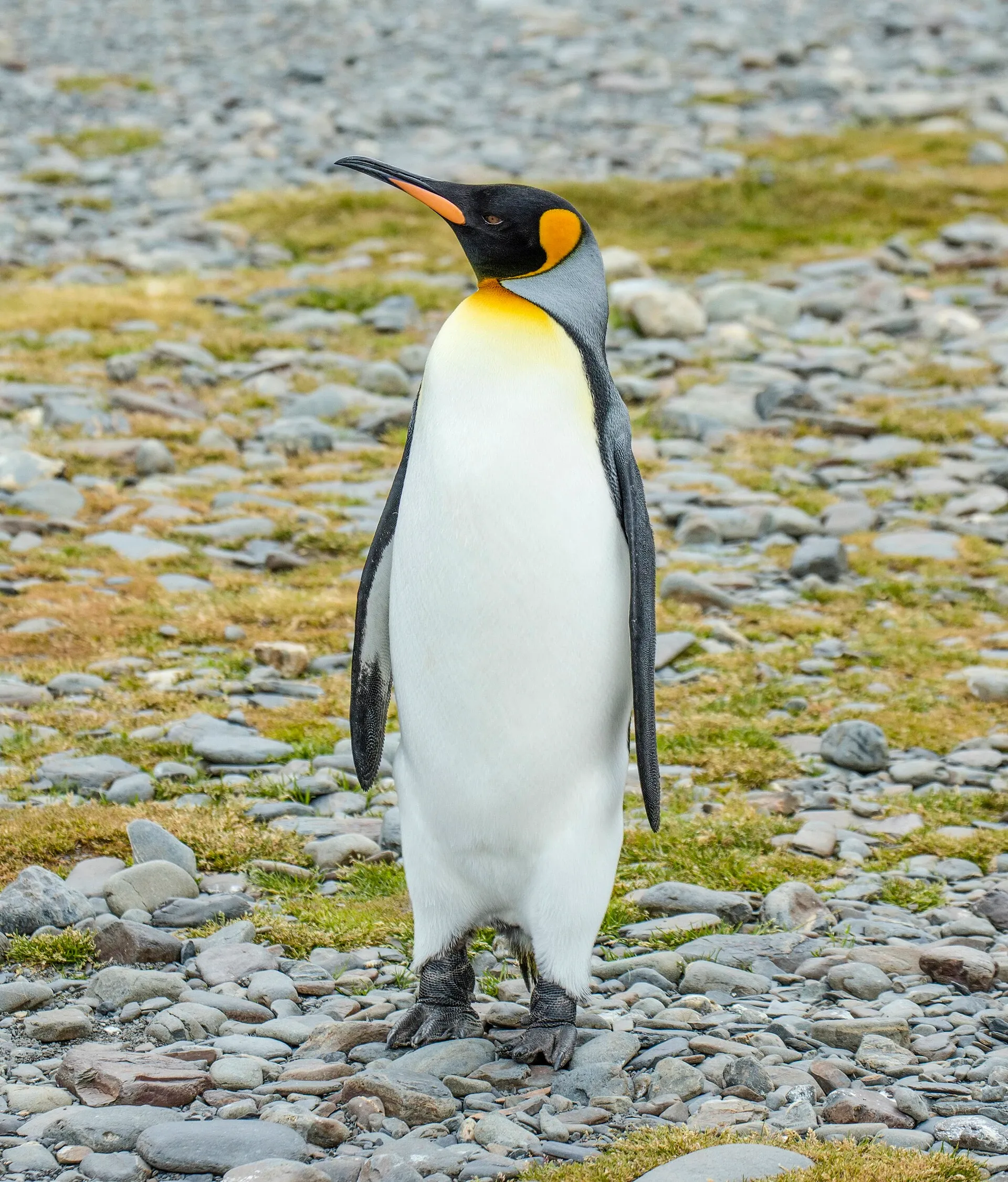
The king penguin is the second-largest penguin in the world, after the emperor. It has a sleek black-and-white coat and glowing golden-orange patches on the sides of its neck. Its bill is longer and more slender than an emperor penguin's, with a colourful stripe along the lower part.
King penguins do not raise their chicks on Antarctic sea ice. Instead they form huge colonies on sub-Antarctic islands such as South Georgia, the Falklands, Crozet and Macquarie. A female lays one egg, and the parents take turns holding it on their feet beneath a warm flap of skin.
Raising a king penguin chick takes a long time — more than a year from egg to independence. Because of that long cycle, pairs usually succeed only in some years. Adults dive deep into the Southern Ocean to catch lanternfish and squid for themselves and their growing chick.
Across the world, king penguin numbers are still large and the IUCN lists the species as Least Concern. Even so, ocean warming and changes in prey can help one colony while making life harder for another. Healthy seas around their island homes are vital for these golden-necked birds.
My home
Coastal islands, rocky shore, beaches, southern ocean
Where I live
Antarctica, Southern Ocean
What I eat
Lanternfish, squid, fish
How heavy I am
9.3–17.3 kg
King penguins keep their single egg warm by balancing it on their feet under a warm fold of skin.
Bright golden-orange patches on the neck help tell a king penguin apart from an emperor penguin.
Raising one chick takes more than a year, so most pairs do not raise a chick every single year.
Every king penguin can feel happy, scared and loved — just like you.
Looking after my friends
How many are there?
The king penguin was assessed as Least Concern in 2020, with a globally increasing trend. Sources describe a very large world population measured in millions of breeding pairs, but they do not agree on one dated global head count with a clear method and geographic scope, so no number is shown.
Scientists may use regional surveys, density or biomass when a worldwide individual count is not practical.
The population in the world was increasing in 2020.
How are they doing?
Lower extinction riskThis species has a lower global extinction risk right now. Local populations can still grow or shrink.
You can help by learning their names, keeping wild places clean, and telling someone why this animal matters.
Where this came from
- Aptenodytes patagonicus (King Penguin) — Red List Assessment — IUCN Red List of Threatened Species
- King Penguin Aptenodytes patagonicus — Species Factsheet — BirdLife International (IUCN Red List Authority for birds)
- King Penguin — British Antarctic Survey
- Aptenodytes patagonicus (king penguin) — Animal Diversity Web, University of Michigan Museum of Zoology