 Real photograph
 Guppy
Poecilia reticulata
say it GUP-ee
Why we love them
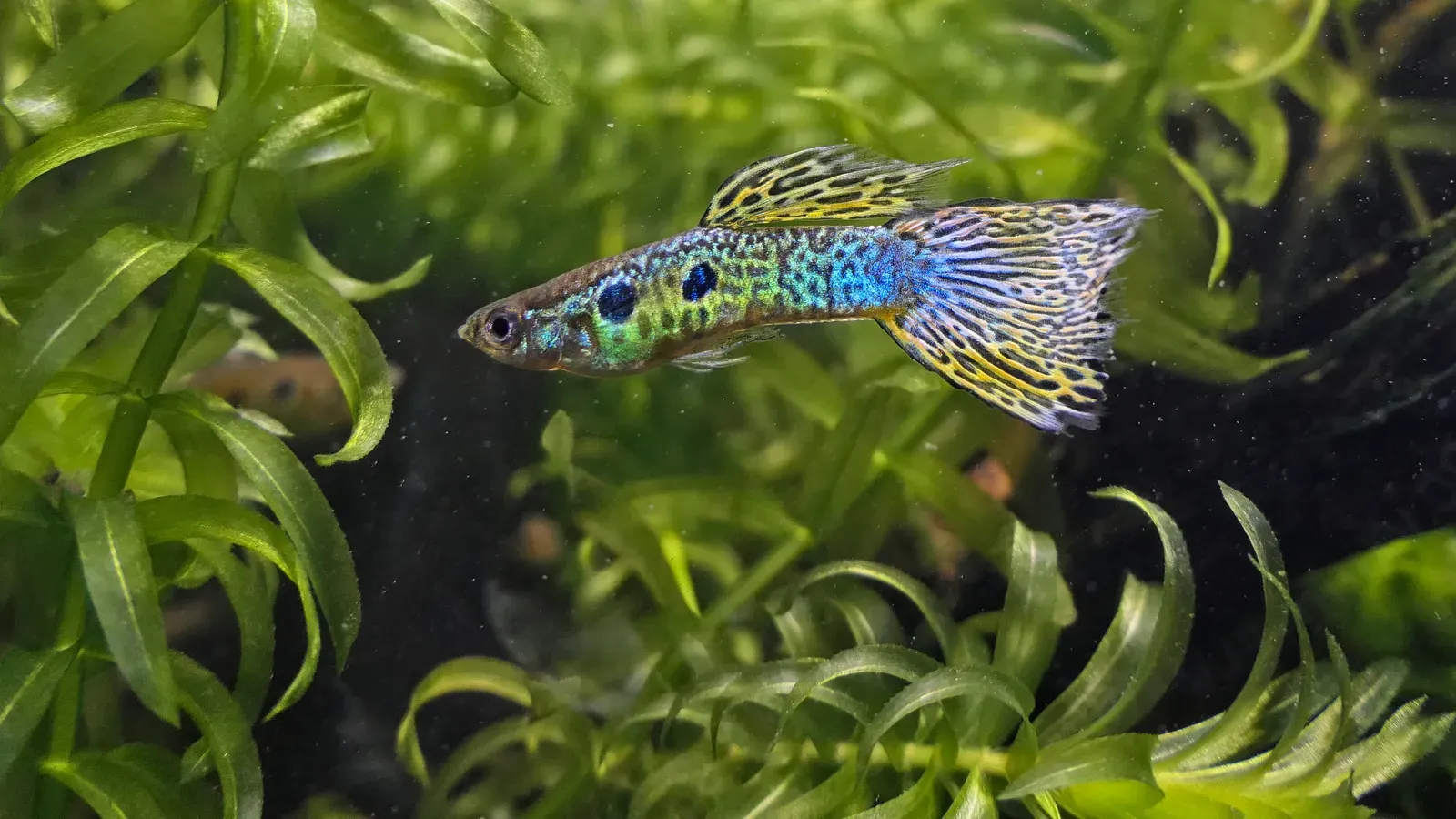
The guppy is one of the smallest and friendliest fish you can imagine. Males are only about 1.5 to 4 centimetres long, and females are a little bigger. What makes them so loved is their colour: male guppies are covered in bright splashes, spots, and stripes, which is why people also call them rainbow fish. The females are a gentle silvery-grey.
Guppies come from the warm fresh waters of northeast South America and nearby Caribbean islands, in places like Trinidad and Tobago, Venezuela, and Guyana. They live in streams, rivers, and ponds, happily swimming together in little groups. They are very easy-going fish and can settle into many different kinds of water, which has helped them travel to warm places all over the world.
One of the most surprising things about guppies is how they have their babies. Instead of laying eggs, mother guppies are livebearers — they give birth to tiny, fully-formed baby fish called fry. The moment they are born, the little fry can swim off and start looking after themselves, often gathering into small schools for safety.
Guppies are omnivores, which means they nibble a bit of everything. In the wild they eat algae, tiny plant bits called diatoms, water insects and their larvae, and drifting specks of food called zooplankton. Being willing to eat so many different things is one reason guppies do so well wherever they live.
Because guppies breed so quickly and so often, they earned the cheerful nickname millionfish, and today they are one of the most widespread tropical fish on Earth. They are listed as Least Concern, which means they are not in danger. Wild guppies still splash happily through the sunny streams of South America, the same warm home their family has always known.
My home
Freshwater stream, river, pond
Where I live
South America, Atlantic Ocean
What I eat
Algae, diatoms, zooplankton, aquatic insect larvae, invertebrates, detritus
How long I am
0.015–0.07 m
How long I live
2 years
Guppies are livebearers — instead of laying eggs, mother guppies give birth to tiny, fully-formed baby fish that can swim away straight away.
Male guppies wear bright splashes, spots, and stripes of colour, while females are a plain silvery-grey, which is why guppies are also called rainbow fish.
Because they breed so easily, guppies are sometimes nicknamed the millionfish, and they are now one of the most widespread tropical fish in the world.
Every guppy can feel happy, scared and loved — just like you.
Looking after my friends
Doing wellThere are lots of these animals in the wild right now. That is good news!
You can help by learning their names, keeping wild places clean, and telling someone why this animal matters.
Where this came from
- Poecilia reticulata (Guppy) — Red List Assessment — IUCN Red List of Threatened Species
- Poecilia reticulata (Rainbow fish) — Animal Diversity Web, University of Michigan Museum of Zoology
- Guppy — Wikipedia