 ← All animals
 shark or ray · Sphyrna mokarran
Great Hammerhead Shark
Gallery
1 photo Real photograph Why we love them
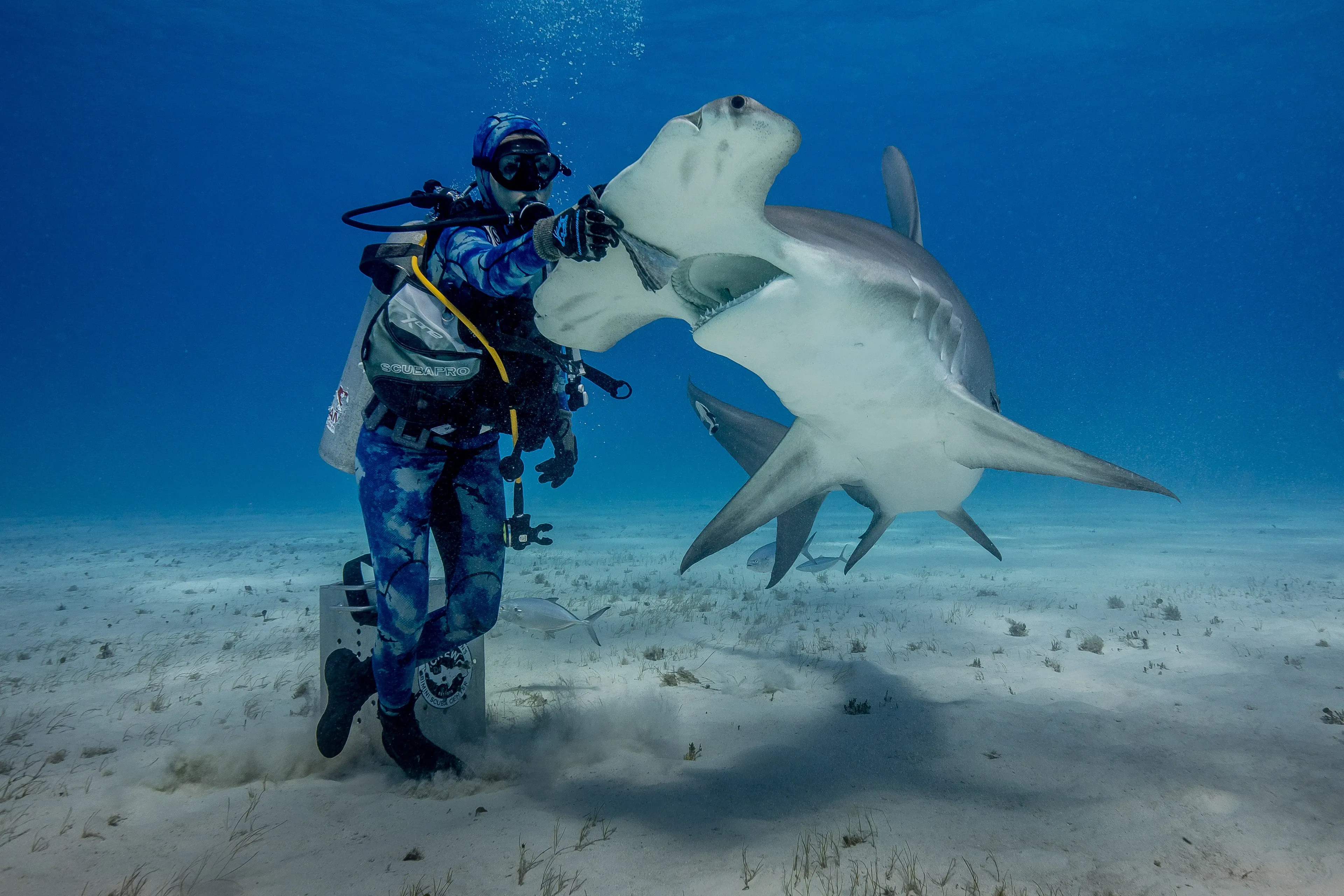
The great hammerhead is the largest of all hammerhead sharks. Its broad head has a nearly straight front edge with a small notch in the middle, while a tall, curved fin rises from its back. These features help distinguish it from the scalloped hammerhead and other close relatives.
That unusual head is called a cephalofoil. Its underside is dotted with tiny sensing pores that pick up the faint electrical signals made by other animals. Spread across the wide head, these sensors help the shark search the seabed for hidden prey such as stingrays.
Great hammerheads live in warm coastal and open waters around the world. They travel over continental shelves, reefs and lagoons, and also swim far offshore. Most are solitary travellers. They eat rays, bony fish, squid, crustaceans and sometimes other sharks.
One of this shark's cleverest swimming tricks looks rather surprising: it often rolls onto one side. In that position, its exceptionally tall dorsal fin works a little like an aeroplane wing. Studies of tagged sharks suggest that this posture reduces drag and helps them travel using less energy.
Great hammerheads grow slowly and females usually have pups only once every two years. This makes it hard for their populations to recover when too many sharks are caught. Fishing, accidental capture in nets and lines, and demand for shark fins have caused steep declines, and the IUCN lists the species as Critically Endangered.
Protecting great hammerheads means improving fishing rules, reducing accidental catch, safeguarding important habitats and controlling international trade. These sharks are powerful ocean predators, but they are also vulnerable animals that need time and space to recover.
My home
Ocean, coastal waters, open ocean, coral reef, lagoon
Where I live
Pacific Ocean, Atlantic Ocean, Indian Ocean
What I eat
Stingrays, other rays, bony fish, sharks, squid, crustaceans
How long I am
2.1–6.1 m
How heavy I am
90–450 kg
How long I live
20–44 years
The great hammerhead is the largest hammerhead species and can grow more than 6 metres long.
Tiny sensing pores spread across its wide head can detect the faint electrical signals of prey hidden beneath the sand.
Great hammerheads often swim rolled onto one side, using their very tall dorsal fin like a wing to make travelling more efficient.
Every great hammerhead shark can feel happy, scared and loved — just like you.
Looking after my friends
How many are there?
The great hammerhead was assessed as Critically Endangered in 2018, with a decreasing global trend and severe modelled declines across three generations. The assessment states that no global population-size data are available, so no present-day head count is shown.
Scientists may use regional surveys, density or biomass when a worldwide individual count is not practical.
The population in the world was decreasing in 2018.
How are they doing?
Critically endangeredThis species has an extremely high risk of extinction in the wild, and urgent conservation work is important.
You can help by learning their names, keeping wild places clean, and telling someone why this animal matters.
Where this came from
- Sphyrna mokarran (Great Hammerhead) — Red List Assessment — IUCN Red List of Threatened Species
- Great Hammerhead — Florida Museum of Natural History
- Shark Identification for the Cooperative Shark Tagging Program — Great Hammerhead — NOAA Fisheries
- Great hammerhead sharks swim on their side to reduce transport costs — Nature Communications