 ← All animals
 bird · Pygoscelis papua
Gentoo penguin
Gallery
1 photo Real photograph Why we love them
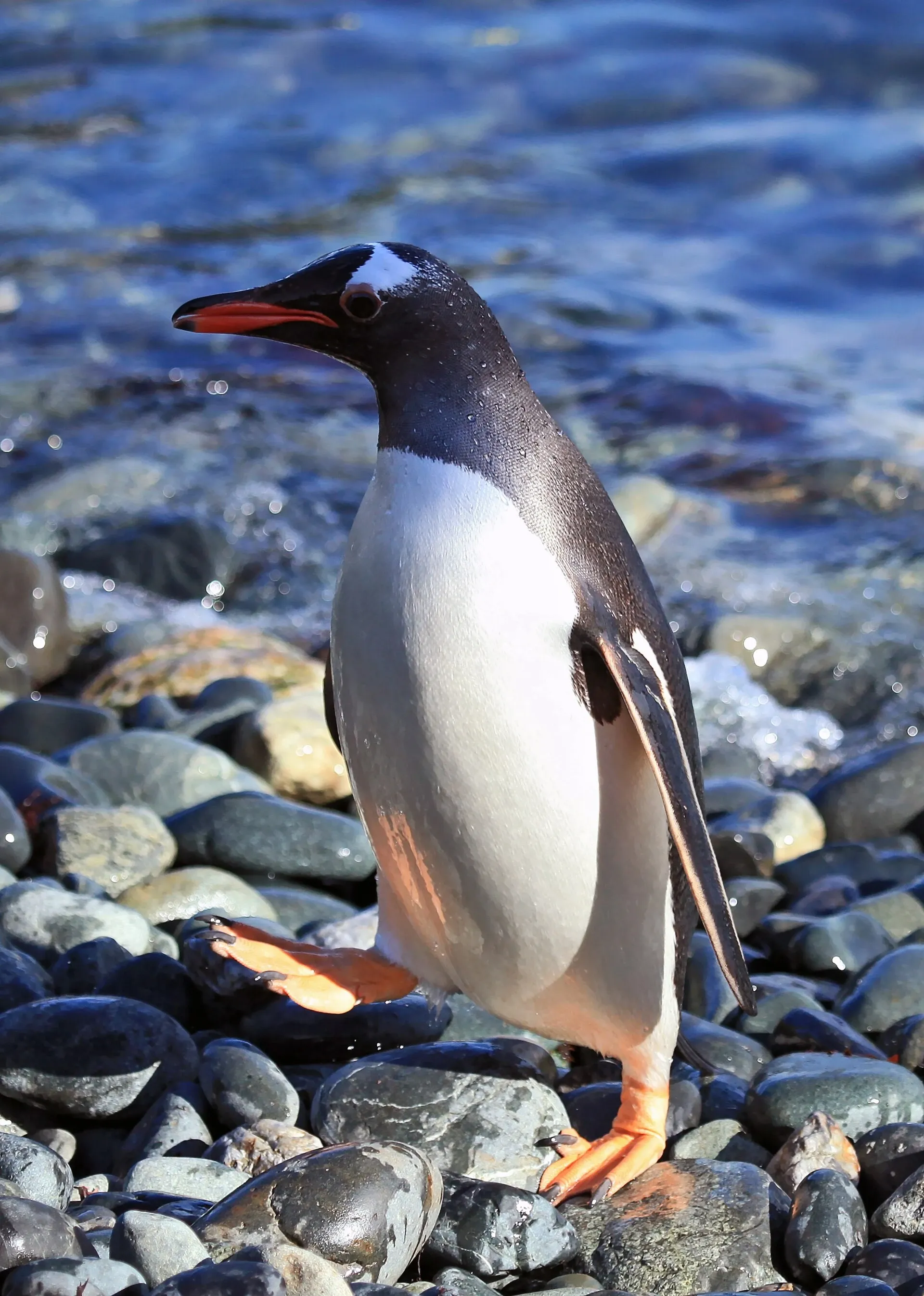
The gentoo penguin is one of the easiest Antarctic penguins to recognise. It has bright orange-red bill colour, pale orange feet and a white band that joins patches above its eyes like a little bonnet. Gentoos are larger than Adélie penguins and have a longer, brush-like tail that can swing from side to side as they walk.
These penguins breed on ice-free beaches, rocky shores and grassy slopes around the Antarctic Peninsula and on many sub-Antarctic islands. A pair usually lays two eggs. Both parents take turns keeping the eggs warm and later bringing back fish, krill and other small ocean animals for their chicks.
Gentoo penguins often stay nearer to shore than some of their relatives. Their menu changes with the seasons and the place they live. Sometimes fish are the main meal; at other times crustaceans such as krill matter more.
The IUCN lists the gentoo penguin as Least Concern, and the overall picture is fairly stable. Still, some colonies have fallen while others have grown. Protecting quiet nesting beaches and healthy coastal seas helps these colourful penguins keep raising the next generation.
My home
Rocky shore, coastal waters, grassy slopes, southern ocean
Where I live
Antarctica, Southern Ocean
What I eat
Fish, krill, crustaceans, squid
How heavy I am
4.5–8.5 kg
A white band over the head and a bright orange bill help identify a gentoo penguin.
A gentoo pair usually lays two eggs and both parents help raise the chicks.
Gentoo penguins often hunt closer to shore than many other Antarctic penguins.
Every gentoo penguin can feel happy, scared and loved — just like you.
Looking after my friends
How many are there?
Between 338,059 and 534,114 breeding gentoo penguin pairs were estimated worldwide in 2020.
Herman and co-authors estimated about 432,144 breeding pairs with a 95% confidence interval of roughly 338,059–534,114. Important geographic survey gaps remain, so this is a synthesis estimate rather than a complete count.
The population in the world was stable in 2020.
How are they doing?
Lower extinction riskThis species has a lower global extinction risk right now. Local populations can still grow or shrink.
You can help by learning their names, keeping wild places clean, and telling someone why this animal matters.
Where this came from
- Pygoscelis papua (Gentoo Penguin) — Red List Assessment — IUCN Red List of Threatened Species
- Gentoo Penguin Pygoscelis papua — Species Factsheet — BirdLife International (IUCN Red List Authority for birds)
- Gentoo penguin — Australian Antarctic Program, Department of Climate Change, Energy, the Environment and Water
- Pygoscelis papua (gentoo penguin) — Animal Diversity Web, University of Michigan Museum of Zoology
- Global abundance and distribution of breeding Gentoo Penguins (Pygoscelis papua) — Polar Biology (Springer)