 Real photograph
 European Rabbit
Oryctolagus cuniculus
say it or-ik-toh-LAY-gus koo-NIK-yoo-lus
Why we love them
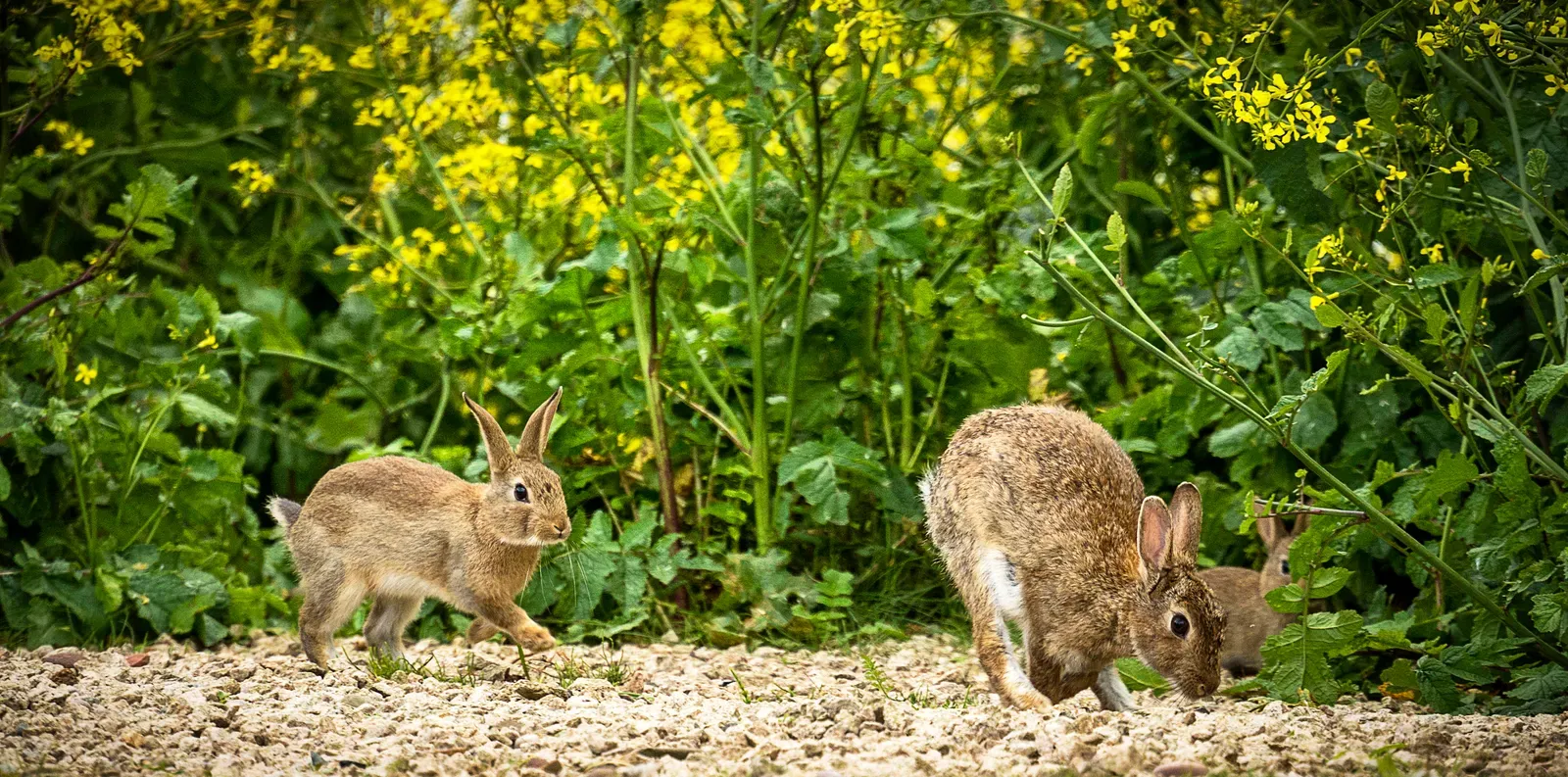
The European rabbit is a soft, furry animal with long ears, a twitchy nose, and a little white tail that flashes when it hops. It first came from the warm, dry lands of Spain, Portugal, and southern France, where it likes grassy fields and low, bushy plants to nibble and hide among.
Rabbits are great diggers. A family of rabbits works together to make a warren, a network of tunnels and cosy rooms deep under the ground. The warren is a safe home where rabbits can sleep during the day and pop up to feed in the cool of the evening and early morning. Rabbits mostly eat grasses, leaves, and clover, and in winter they will nibble roots and bark too.
Baby rabbits are called kits. They are born tiny, pink, and blind in a snug nest, and their mother lines it with soft fur from her own body to keep them warm and hidden. A mother rabbit can raise several litters of kits in a single year, so a warren can quickly grow into a big, busy family.
Here is something surprising. In the rabbit’s own homeland in Spain and Portugal, there are far fewer wild rabbits than there used to be, and they are now counted as endangered. Rabbits matter a lot there, because many other animals depend on them, so people are working to help their numbers grow again.
In other parts of the world the story is very different. Long ago, people carried rabbits to places like Australia, where there were no natural checks to slow them down. There the rabbits bred so fast that they became one of the most common animals in the whole country. It is a good reminder that the same animal can need our help in one place and cause a big change to the land in another.
My home
Grassland, scrubland, woodland edge, farmland
Where I live
Europe, Oceania
What I eat
Grasses, leaves, clover, roots, bark
How long I am
0.34–0.45 m
How heavy I am
1.5–3 kg
How long I live
1–9 years
Baby rabbits, called kits, are born in a cosy underground nest with their eyes closed and no fur, so the mother lines the nest with soft fur pulled from her own tummy to keep them warm.
European rabbits live together in big groups and dig a maze of connected tunnels and rooms under the ground called a warren.
In their home countries of Spain and Portugal, wild rabbits have become endangered, yet in faraway places like Australia, where people brought them long ago, they spread into the millions.
Every european rabbit can feel happy, scared and loved — just like you.
Looking after my friends
Needs our helpThere are not many left, but people all over the world are helping them recover.
You can help by learning their names, keeping wild places clean, and telling someone why this animal matters.
Where this came from
- Oryctolagus cuniculus (European Rabbit) — Red List Assessment — IUCN Red List of Threatened Species
- Oryctolagus cuniculus (European rabbit) — Animal Diversity Web, University of Michigan Museum of Zoology
- European rabbit — Wikipedia