 Real photograph
 Blue whale
Balaenoptera musculus
say it BLOO WAYL
Why we love them
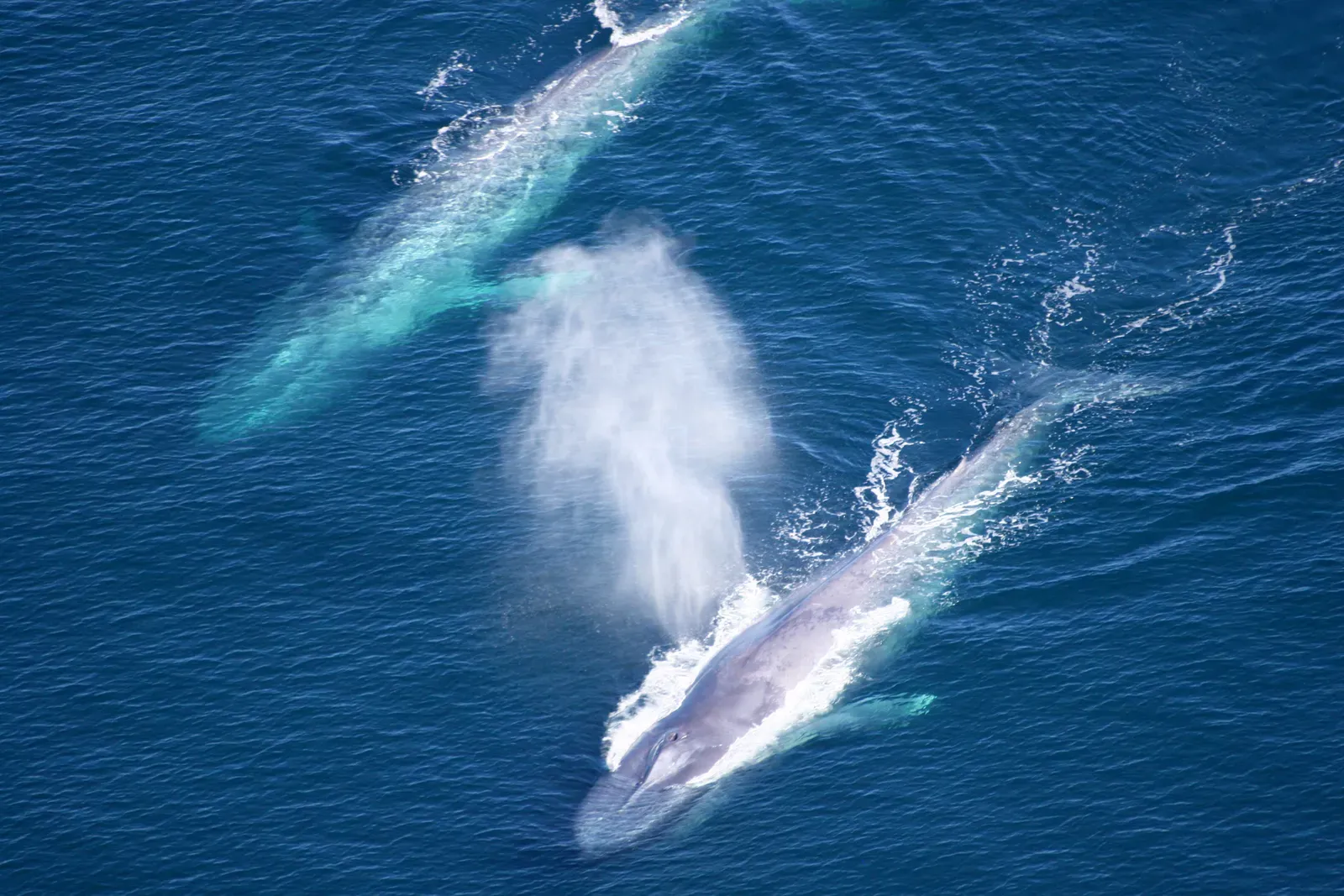
The blue whale is the biggest animal that has ever lived on our planet. It is longer than a bus and heavier than a group of elephants all put together. Its smooth body is a soft blue-grey colour, and it glides through the sea by sweeping its huge tail up and down.
Blue whales live in oceans all around the world, in every sea except the icy Arctic. They often swim alone or in pairs. In summer they feed in cold waters near the poles, and as winter comes they travel a long way toward warmer seas.
For such a giant, the blue whale eats very tiny food. It gulps a great mouthful of water full of little shrimp-like animals called krill, then pushes the water back out with its tongue. Stiff, comb-like plates called baleen keep the krill trapped inside so the whale can swallow them.
Blue whales are among the loudest animals on Earth. They make deep pulses, groans, and moans that travel through the water for hundreds of kilometres. Scientists think these sounds help far-apart whales talk to one another across the wide, dark ocean.
Long ago, people hunted so many blue whales that very few were left, and today they are still an endangered animal. Now they are protected, and hunting them is not allowed. Slowly their numbers are climbing again, so there is real hope for these gentle giants of the sea.
My home
Ocean, open ocean, polar seas
Where I live
Pacific Ocean, Atlantic Ocean, Indian Ocean, Southern Ocean
What I eat
Krill
How long I am
24–30 m
How heavy I am
100000–130000 kg
How long I live
80–90 years
The blue whale is the largest animal known to have ever lived on Earth.
It is one of the loudest animals on the planet, and its calls can travel across the ocean for hundreds of kilometres to reach other whales.
Even though it is so enormous, the blue whale eats tiny shrimp-like animals called krill, straining them from the water with comb-like plates called baleen.
Every blue whale can feel happy, scared and loved — just like you.
Looking after my friends
Needs our helpThere are not many left, but people all over the world are helping them recover.
You can help by learning their names, keeping wild places clean, and telling someone why this animal matters.
Where this came from
- Balaenoptera musculus (Blue Whale) — IUCN Red List Assessment — IUCN Red List of Threatened Species
- Blue Whale | NOAA Fisheries — NOAA Fisheries
- Blue whale — Wikipedia