 Real photograph
 Atlantic puffin
Fratercula arctica
say it at-LAN-tik PUFF-in
Why we love them
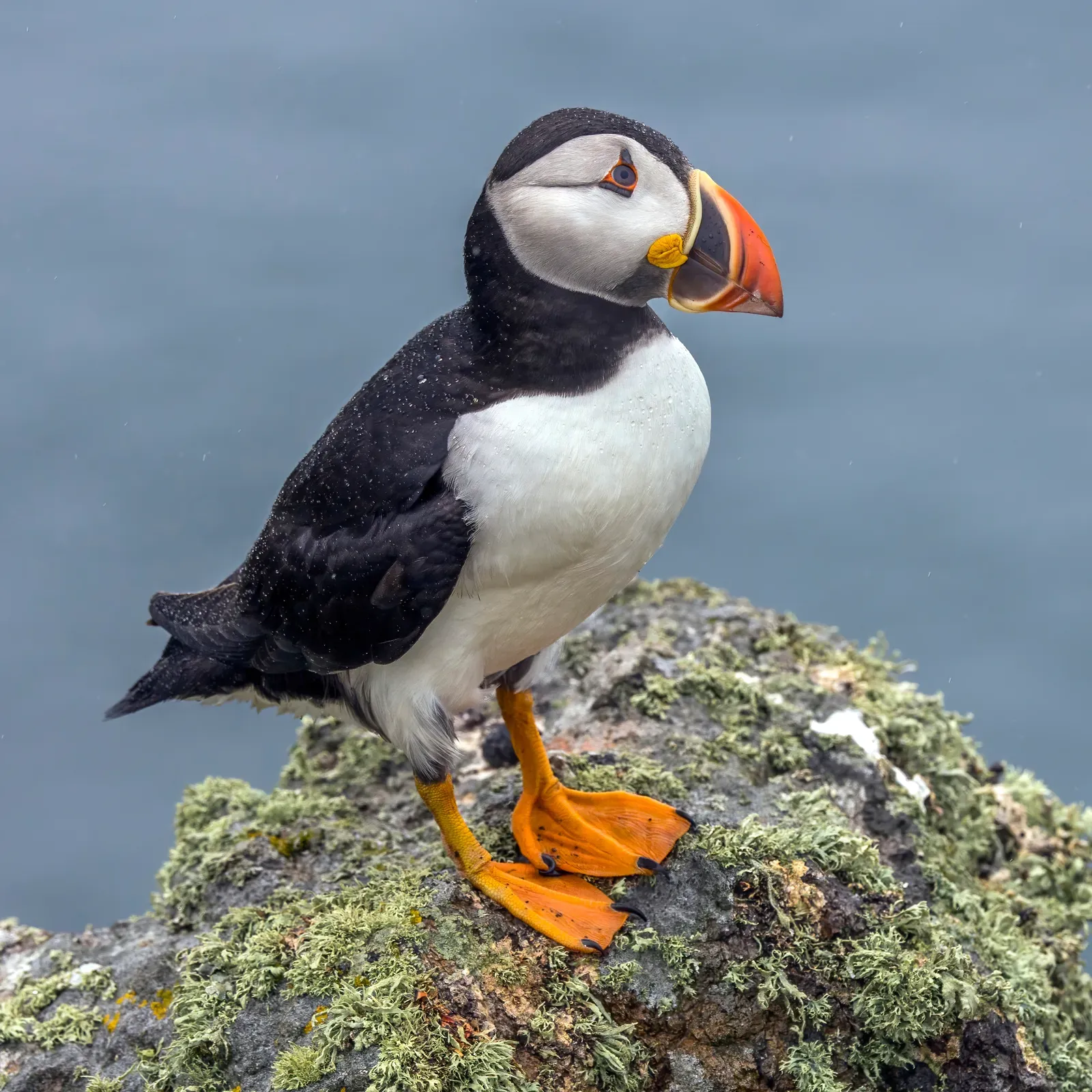
The Atlantic puffin is a small, round seabird about the size of a crow. In summer it wears a big, brightly striped bill of orange, red, and yellow, and it has bright orange feet with webbing between the toes. Its neat black-and-white feathers make it look a little like it is wearing a smart suit.
Puffins spend most of their lives far out on the open sea and only come to land to raise their chicks. They are wonderful swimmers. A puffin flaps its wings to “fly” underwater and uses its feet to steer, and it can dive down quite deep to chase after fish.
For dinner, puffins catch small fish such as sand lance, herring, and capelin. When they have chicks to feed, the parents carry the little fish back to the nest in their colourful bills.
In spring, puffins gather in big, busy groups called colonies on grassy cliff tops. Each pair digs a cosy burrow in the soil, or tidies up an old one, and the two birds say hello by rattling their bills together. More puffins live around the island of Iceland than anywhere else on Earth.
There are still many millions of Atlantic puffins, but in some places their numbers have been going down, so scientists now watch over them carefully. People help by looking after the islands where puffins nest, keeping away animals that might bother them, and making sure the sea holds plenty of fish for puffins to catch.
My home
Ocean, open ocean, sea cliffs, coastal islands
Where I live
Europe, North America, Atlantic Ocean
What I eat
Sand lance, herring, capelin, cod
How long I am
0.25–0.33 m
How heavy I am
0.31–0.55 kg
A puffin flaps its wings to "fly" underwater and steers with its feet, and it can dive down about as deep as a tall building is high.
In summer a puffin's bill is bright orange, red, and yellow, but in winter it becomes smaller and duller when the outer parts fall off.
More Atlantic puffins live around Iceland than anywhere else, about six out of every ten in the whole world.
Every atlantic puffin can feel happy, scared and loved — just like you.
Looking after my friends
Needs our helpTheir numbers are getting smaller, so people are working to protect their homes.
You can help by learning their names, keeping wild places clean, and telling someone why this animal matters.
Where this came from
- Fratercula arctica (Atlantic Puffin) — Red List Assessment — IUCN Red List of Threatened Species
- Atlantic Puffin — Life History — Cornell Lab of Ornithology (All About Birds)
- Atlantic Puffin — Field Guide — National Audubon Society
- Atlantic puffin — Wikipedia